


For many music lovers, choosing between streaming platforms is no longer just about catalog size - it's about audio quality, device compatibility, and listening experience. While Apple Music offers a massive library and seamless integration within the Apple ecosystem, more users are turning to Tidal for its Hi-Res streaming, FLAC support, and superior playback with external DACs.
This shift is especially noticeable among audiophiles and DJs who want more control over how their music sounds and where it plays. However, moving from Apple Music to Tidal isn't as simple as pressing a 'transfer' button. Apple Music uses DRM protection, and its downloads are not directly compatible with other platforms. So how do you bridge this gap? In this guide, we'll walk through two practical approaches for your best music experience.


Part 1. How to Convert Apple Music to Local Files for Hi-Res DAC Playback on Tidal
Before diving into playlist transfers, it's important to understand a key limitation: Apple Music tracks cannot be directly imported into Tidal's streaming library. That means if your goal is to 'move' songs in a literal sense, you'll need to rethink the workflow.
Instead of syncing Apple Music playlists to Tidal, a more realistic and consistent approach is to convert your Apple Music tracks into standard audio formats and use them alongside Tidal for playback, especially in Hi-Res DAC setups.
The Key Features of Converting Apple Music to Local Files
Apple Music downloads are encrypted and tied to your subscription. Once converted into local formats such as FLAC, WAV, or MP3, your music becomes:
- Import them into other platforms like Tidal
- Playable on any device, including Hi-Fi systems like Roon
- Compatible with external DACs (Digital-to-Analog Converters)
- Independent of subscription and app limitations
- Consistent seamless streaming without buffering
Recommended Tool: AudFree Apple Music Converter
Because Apple Music tracks are encoded in M4P (protected AAC) format, they cannot be moved directly to other platforms. To listen to your Apple Music library on Tidal or other hardware, you must first convert them into a universal, DRM-free format.
AudFree Apple Music Converter is a premier solution specifically engineered for this task. It is a professional-grade software capable of batch-downloading Apple Music songs, albums, and playlists into various formats including MP3, FLAC, WAV, AIFF, and M4A.
Powered by advanced conversion technology, it preserves 100% lossless sound quality and retains all original ID3 tags (titles, artists, album art, etc.). Whether you are moving a massive library or exclusive tracks, AudFree Apple Music Downloader makes the transition to Tidal seamless.
AudFree Apple Music Converter

- Losslessly convert Apple Music to MP3, M4A, FLAC, etc.
- Download tracks as permanent local files for Tidal or Roon
- Process tracks in batches at up to 17× speed
- Maintain lossless audio quality for Hi-Res listening
- Keeps all metadata and high-resolution cover art intact
How to Convert Apple Music for Tidal Hi-Res Streaming
Below is a step-by-step guide to help you convert Apple Music tracks into high-quality local files.
See also: How to Download Apple Music for Windows
- Step 1. Add Apple Music to AudFree Apple Music Downloader

- Install and launch the AudFree Apple Music Converter on your PC or Mac. Sign in to your Apple Music account within the built-in web player. Browse your library, locate the songs or playlists you wish to move, and click the '+' (Add) button to load them into the conversion queue.
- Step 2. Customize Output Settings of Apple Music

- To ensure compatibility with Tidal's Hi-Res standards, click the 'menu icon > Preferences > Conversion'. Here, choose FLAC or WAV for lossless quality, or MP3 for maximum compatibility. You can manually adjust the bitrate, sample rate, channels, and more. At last, select your preferred output folder under 'Output' section.
Tidal currently supports FLAC, WAV, MP3, AIFF, and AAC for local file integration.
- Step 3. Download Apple Music with DRM-Free

- Click the 'Convert' button at the bottom-right of the interface. The software will process your files in batches, stripping the DRM and saving them to your local storage. Once the process is complete, these files are yours to keep and play on any offline device.
- Step 4. Integrate Apple Music Files with Tidal
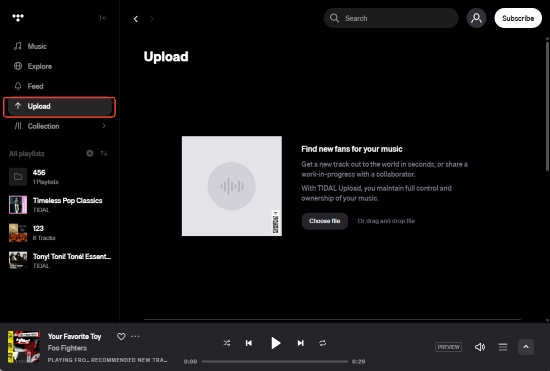
- With your DRM-free Apple Music files ready, you can now add them to your Tidal experience:
- Option 1. Open the Tidal app, click the 'Upload' icon, and select your converted files. Set them to 'Private' to sync them across your devices.
- Option 2. Because direct uploads can sometimes be flagged by copyright filters, many users prefer using Roon. Simply point your Roon Core to the folder containing your AudFree downloads. Roon will merge these local files with your Tidal subscription, creating one unified, high-fidelity library.
The upload feature is primarily intended for personal audio, such as your own demos, bootlegs of your own performances, or unreleased tracks. You can technically upload any files and set them to "Private", but Tidal's system is designed to detect copyright. Please be aware that commercial music may fail to upload due to copyright detection filters (e.g., a Taylor Swift or Ariana's song).
Using AudFree Apple Music Converter gives flexibility to break platform limitations and enjoy your music freely. While it doesn't directly transfer songs into Tidal, it gives you complete ownership and playback flexibility, especially for Hi-Res DAC setups.
Full control over your music;
Works with any DAC or Hi-Fi system;
Preserves Hi-Res quality;
No platform restrictions
Hard to integrate into Tidal's native library (or use Roon);
Requires extra software
If you use multiple streaming platforms, consider the AudFree Streaming Audio Recorder. This versatile tool is compatible with over 10 major platforms and offers the same high-fidelity output and metadata retention as the Apple Music Converter. It is an excellent solution for users who want to maintain a consistent, DRM-free music archive.
Part 2. How to Move Apple Music Playlist to Tidal via Music Migration Tools
If your primary goal is to keep your playlists intact rather than your actual files, then music migration tools are the most efficient solution.
Unlike file conversion, these tools don't download or move audio files. Instead, they:
- Scan your Apple Music playlists
- Match each track within Tidal's catalog
- Recreate the playlist automatically
These music migration tools include Soundiiz, TuneMyMusic, and FreeYourMusic. Below, we'll show the workflow of the three tools one by one.
1. Soundiiz
Soundiiz is a powerful web-based utility for migrating your library from Apple Music to Tidal. While highly effective, users should be aware that the free tier limits the number of tracks you can sync at once (maximum of 200 tracks per playlist). Additionally, because it is a cloud-based tool, the transfer speed may fluctuate based on your internet connection stability.

Step 1. Visit the Soundiiz website and log in to both your Apple Music and Tidal accounts.
Step 2. Select the 'Platform to Platform' tool and set Apple Music as your source. Choose the specific playlists or albums you wish to migrate.
Step 3. Set Tidal as your destination and click to begin the transfer process
2. TuneMyMusic
TuneMyMusic is a popular online utility that allows you to sync Apple Music songs to Tidal entirely online. It is known for its speed and intuitive user interface, making it an excellent choice for quick, browser-based migrations. However, the free tier is limited to a total transfer of 500 tracks.

Step 1. Navigate to the TuneMyMusic website and click the "Let's Start" button.
Step 2. Choose Apple Music as your source service and authorize the connection to your account.
Step 3. Select Tidal as the destination platform. Review the songs you want to move and click 'Start Transfer' to begin the synchronization.
3. FreeYourMusic
FreeYourMusic is a dedicated desktop and mobile application designed for transferring playlists from Apple Music to Tidal. Unlike web-based tools, this software runs locally on your device. While the free version has similar track synchronization limits to Soundiiz, it offers a more stable interface for large-scale migrations.

Step 1. Download and install FreeYourMusic on your computer or mobile device.
Step 2. Select Apple Music as your source platform and Tidal as your destination service.
Step 3. Select the playlists you wish to move and click to begin the transfer process.
Fast and beginner-friendly, transfers thousands of songs in minutes;
The premium version offers cross-device sync;
No need to download or convert files;
No need to keep your computer on or manage local storage
Some songs may not transfer (if they aren't in Tidal's database);
Requires a stable internet connection;
No control over audio file formats;
If the song is removed from Tidal, it disappears from your playlist;
Exists incorrect matches (e.g., matching a studio recording with a live version)
Part 3. FAQs About Transferring Apple Music to Tidal
Can Apple Music songs be uploaded and synced to Tidal with metadata preserved?
No, you can't directly sync Apple Music tracks to Tidal because they are protected by DRM (M4P format). However, if you convert them into DRM-free files using tools like AudFree Apple Music Converter, you can use them as local files with preserved metadata. Keep in mind that some files may not be usable due to copyright restrictions.
What happens to unmatched songs when moving from Apple Music to Tidal?
Unmatched Apple songs are simply skipped during the transfer and won't appear in your Tidal playlist. This usually happens because the track isn't available on Tidal, the metadata doesn't match closely enough, or the specific version (such as a remix or live recording) cannot be identified. Most migration tools provide a report of these unmatched tracks so you can search for alternatives manually.
How does Tidal Connect compare to AirPlay?
Tidal Connect and AirPlay both let you stream music to external devices, but they differ in three key ways.
1. Streaming Path: With AirPlay, the music streams from the internet to your phone, and then from your phone to the speaker. This drains your phone's battery. With Tidal Connect, your speaker streams the music directly from the cloud, and your phone acts only as a remote control.
2. Audio Quality: Tidal Connect is superior for audiophiles because it supports Bit-Perfect Hi-Res audio (up to 24-bit/192kHz). AirPlay 2 typically caps audio at 16-bit/44.1kHz (CD quality) and may involve downsampling.
3. Reliability: With Tidal Connect, your music won't be interrupted by phone calls, videos, or if you walk out of Wi-Fi range. AirPlay will stop the music if the connection between the phone and the speaker is broken.
See also: Tidal vs Apple Music
Conclusion
Moving from Apple Music to Tidal isn't a one-click process, but it's far from impossible. By understanding the differences between file ownership and streaming access, you can choose the right strategy for your needs. With the right tools (especially AudFree Apple Music Downloader) and a clear strategy, you can enjoy the best of both worlds, without sacrificing your music library or listening experience.

Staff Editor


