


For years, digital DJs faced a massive hurdle: streaming libraries were heavily segregated. If you spent years meticulously building playlists on Apple Music, you were completely locked out of using them on professional performance software. You either had to repurchase your entire library track by track or switch your loyalty to a different ecosystem.
Fortunately, Algoriddim announced an official integration between djay Pro and Apple Music since February 2024. Now, in 2026, this partnership has completely matured, allowing mobile mixing enthusiasts and bedroom mashup artists alike to access over 100 million tracks in the djay Pro app instantly.
In this comprehensive 2026 guide, we will look at how to natively connect Apple Music to djay Pro, break down the critical limitations you need to know before playing a live platform, and reveal an advanced workflow to unlock 100% offline DJing and unrestricted mix recording.


Part 1. Does djay Pro Work with Apple Music?
The short answer is yes, absolutely.
Algoriddim's djay Pro offers comprehensive native integration with Apple Music across almost all major operating systems. Whether you are mixing on a flagship MacBook Pro, an iPad, an iPhone, a Windows desktop, or even an Android device, you can log directly into your streaming account from within the DJ interface.
To take advantage of this setup, you need to ensure you meet three basic requirements:
- An Active Apple Music Subscription: This feature is not available to free trials that have expired or standard Apple ID accounts without a paid monthly plan ($10.99/month for individuals).
- The Latest Version of djay Pro: Ensure your software is updated via the Mac App Store or Windows Microsoft Store to prevent API handshake errors.
- A Stable Internet Connection: Because this is a cloud-streaming protocol, your system needs to constantly pull metadata and high-fidelity audio streams from Apple's servers in real-time.
Keep in mind that djay Pro streams these tracks directly from Apple's servers rather than storing them permanently on your drive as standard audio files. Because of this cloud-dependent framework, a few advanced DJ features remain restricted - a topic we will dive into deeply during Part 3.
Part 2. How to Connect Apple Music to djay Pro (Official Way)
Now that you've checked off the basics, you're ready to bridge the two platforms, djay Pro and Apple Music. Follow these step-by-step instructions to link your Apple credentials to djay Pro on a Mac or PC:
Step 1. Open the application on your computer and ensure you are in the main performance layout (such as the 2-Deck or Pro view).

Step 2. Look at the bottom half of your screen where your music collection is managed. On the left-hand sidebar, you will see a list of available music sources (such as My Collection, Finder, TIDAL, etc.).

Step 3. Click on the distinct Apple Music logo. If it is your first time clicking it, the main display panel will present a welcome screen with a prominent 'Sign In' button.
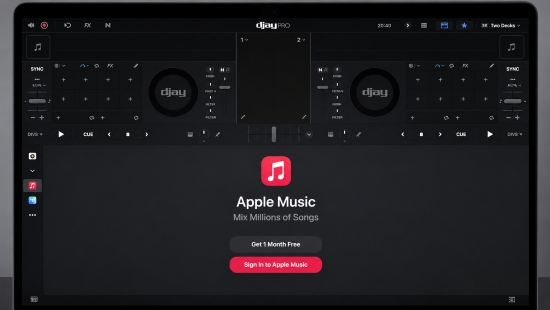
Step 4. A secure, native web pop-up window will appear prompting you for your Apple ID credentials. Then enter your email and password. If you have two-factor authentication (2FA) enabled, verify the prompt on your phone or trusted device.
Step 5. Once authorized, djay Pro will instantly load your personal infrastructure. You will see your custom playlists, favorite albums, top charts, and the global Apple Music search engine ready to match any request on the fly.
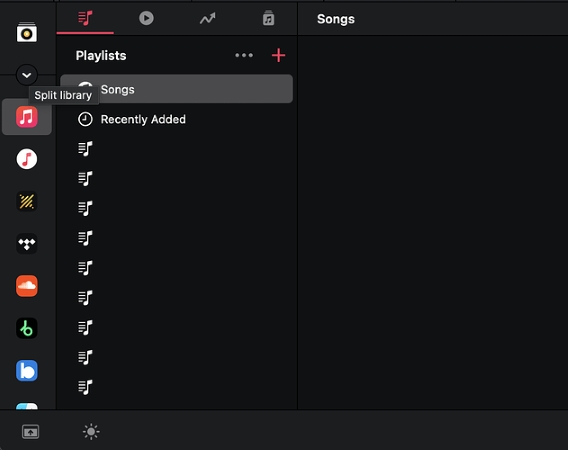
If you frequently use Siri or your iPhone to organize music, any playlist modifications you make on your phone will sync across the cloud and update inside your djay Pro library panel in real-time.
Part 3. Limitations of Apple Music djay Pro Integration
While dropping an Apple Music track seamlessly onto a virtual deck feels incredible, professional mixing environments require absolute reliability and stability. Unfortunately, the official djay and Apple Music integration comes with several strict corporate and technical limitations.
Before you risk relying on this setup for a paid event, a mixtape project, or a live gig, you must consider these five critical limitations:
1. Mandatory, High-Speed Internet Access Required
Because Apple Music tracks are strictly streamed into djay Pro, your entire set becomes entirely dependent on a live internet connection. Every time you load a track, the software has to buffer the high-fidelity audio data from Apple's cloud servers in real-time.
❌ The Performance Risk: If your venue has poor Wi-Fi, thick concrete walls that block cellular signals, or congested mobile networks, songs will lag, fail to load, or suffer from audio buffering mid-set. This unpredictable infrastructure is one of the single biggest anxieties for professional club, wedding, and mobile event DJs.
While permanent offline downloading isn't supported, djay Pro automatically caches each Apple Music track into RAM when loaded. Once the full waveform populates, playback remains uninterrupted even if your internet drops.
2. No Permanent Music Ownership
When you build a DJ library using a streaming provider, you do not actually own the music. You are essentially renting access to a massive catalog instead.
❌ The Performance Risk: If your monthly subscription expires or encounters a billing issue, your access is cut off instantly. Furthermore, because music labels constantly renegotiate contracts, tracks can be suddenly removed from Apple Music or undergo licensing changes overnight, leaving your meticulously prepared playlists with missing songs right before a show.
3. Highly Restrictive Offline Access
A common point of confusion for digital DJs is assuming that standard offline downloading carries over between apps. Unfortunately, Apple Music downloads inside the native macOS Music app do not automatically become available inside djay Pro. You cannot pre-download an Apple Music playlist inside djay Pro to protect yourself from a network failure. No internet means no music.
❌ The Performance Risk: Even if you have downloaded thousands of songs to your Mac's local hard drive for offline listening via the Apple Music app, djay Pro cannot read those encrypted files. Its native integration remains strictly online-only, offering zero built-in offline caching protection.
4. Severe Recording Restrictions (DRM Lockout)
Digital Rights Management (DRM) is heavily enforced through the Apple Music API. Because streaming licenses do not cover the redistribution or creation of new audio assets, certain core recording workflows are completely blocked.
❌ The Performance Risk: The second you select Apple Music as your active source, djay Pro's internal audio recorder is disabled. This prevents you from recording your live mixes, practicing seamless transitions, uploading promotional sets to platforms like SoundCloud, or creating audio content to market your DJ business.
5. Neural Mix & Stem Separation Lockout
This is a critical pitfall that catches countless modern DJs off guard. Algoriddim's Neural Mix is a revolutionary engine that allows real-time stem separation, but its availability depends entirely on the source of your file.
❌ The Performance Risk: If you load an active streaming track directly from the Apple Music tab in djay Pro, the Neural Mix controls will instantly lock up and turn gray. This isn't a technical failure on Algoriddim's part; it is a strict legal restriction enforced by major record labels. Copyright holders strictly prohibit third-party apps from stripping vocals or instrumentals from rented streams. (This block also applies to TIDAL, SoundCloud, and Beatport streaming links).
Unprotected local music files (such as MP3, WAV, or FLAC) are 100% fully supported by the Neural Mix engine. Loading true local files completely unleashes the software, allowing you to isolate or mute Vocals, Drums, and Harmonics in real-time to create perfect, live mashups on stage.
Ultimately, these combined technical roadblocks make a pure cloud-streaming setup a massive gamble for any live performance environment. To protect your reputation from spotty venue Wi-Fi, record your live sets without corporate lockouts, and fully unlock the creative power of real-time stem separation, you need a way to bring your cloud music down to earth.
In the next section, we will reveal the absolute best method to take your Apple Music library completely offline for djay Pro.
Part 4. How to Use Apple Music on djay Pro for Offline DJing & Recording
The official Apple Music integration makes it easy to access millions of songs inside djay Pro, but it isn't ideal for every DJ scenario. If you're performing at venues with unreliable internet, traveling frequently, or need to record and archive your mixes, relying solely on streaming can be risky.
A more dependable workflow is to create a local DJ library from your Apple Music collection. By converting Apple Music tracks into standard audio formats, you can store them directly on your computer and import them into djay Pro just like any other music file. This allows you to perform offline, back up your music library, and enjoy greater flexibility when organizing your DJ collection, including record and export your real-time mixes.
One tool commonly used for this purpose is AudFree Apple Music Converter. It can convert Apple Music tracks into widely supported formats such as MP3, WAV, FLAC, AIFF, and M4A while preserving important metadata, including song titles, artists, album artwork, and track information. The software also supports batch conversion and customizable output settings, making it easier to prepare large playlists for DJ use.
Audio Format Compatibility
| Audio Formats Supported by djay Pro | Audio Formats Output by AudFree |
|---|---|
| MP3, FLAC, WAV, AIFF, M4A, OGG, and more | MP3, FLAC, WAV, AIFF, M4A, M4B |
AudFree Apple Music Converter

- Remove DRM from Apple Music and save as lossless audio file
- convert Apple Music to MP3, FLAC, and other Djay Pro-supported formats
- Up to 17x faster conversion speed
- Retain original audio quality and ID3 tags
- Customize the audio format and advanced parameters of Apple Music
How to Convert Apple Music for Djay Pro
- Step 1. Customize Apple Music Output Format and Other Preferences

- Download and launch the AudFree application on your Mac or Windows. Here, take a Mac computer as an example. Before adding your music, click on 'AudFree Apple Music Converter' in your system's top menu bar and navigate to 'Preferences > Conversion'. You can also select some advanced audio parameters, including audio channel, bitrate, sample rate, and more.
- For Maximum Compatibility: Set the output format to MP3 (320kbps).
- For Audiophile/Club Sound Systems: Set the format to WAV or FLAC (24-bit) to retain maximum dynamic range.
- Step 2. Import Apple Music to AudFree Apple Music Converter

- Then log in to your Apple Music account within the built-in web player. Browse your Amazon Music library or curated playlists, and click the '+' button in the bottom-left corner of the AudFree interface to load these you intend to use in your upcoming DJ performance, and click 'Add to List'.
- Step 3. Convert Apple Music to Local Files for djay Pro

- Click the 'Convert' button to begin the process. Once complete, your newly unencrypted songs will be saved directly to your local hard drive. From there, you have the total freedom to back them up, transfer them to any device, and import them straight into djay Pro for flawless, unrestricted mixing.
If you want to source music from other platforms for your djay Pro gigs, the AudFree Streaming Audio Recorder is the perfect all-in-one companion. Much like the dedicated AudFree Apple Music Converter, this versatile tool gives you the flexibility to capture high-fidelity, lossless audio from over 10 major streaming networks - including Spotify, TIDAL, and Qobuz - ensuring your local DJ crates are always packed, portable, and completely unrestricted.
How to Import Converted Apple Music to djay Pro
Once your files are converted, you can import them into djay Pro immediately. Because these are now genuine local files, the internal Record button and Neural Mix stems will be fully functional.
On macOS:

Step 1. Open djay Pro (e.g., Djay Pro 2) and locate the Library Browser in the lower section of the interface.
Step 2. Instead of clicking the Apple Music streaming option, click on the Finder or My Collection tab.
Step 3. Click Add Folder and select the local directory where AudFree saved your new audio files.
On Windows:
Step 1. Launch djay Pro and navigate to the library panel in the bottom-left corner of the window.
Step 2. Click on the Explorer tab. (Note: You can also use the My Collection or Music Playlists tabs if you prefer to organize your music via the Windows Media Player or iTunes ecosystem).
Step 3. Under the Explorer section, click Add Folder and choose the local hard drive directory containing your Apple Music converted audio.
With your files successfully mapped, you now have total creative freedom. You can analyze keys, manipulate real-time stems, and record your live mixes directly inside djay Pro with zero network lag or DRM restrictions.
Comparison of Cloud Apple Music Files vs Converted Local Files
| Feature | Official Apple Music Integration | Converted Local Files (via AudFree) |
|---|---|---|
| Offline DJing | ❌ | ✅ |
| Mix Recording | ❌ | ✅ |
| Neural Mix (Stems) | ❌ | ✅ |
| Supported Audio Formats | Streaming-only Apple Music tracks (Cloud-locked AAC) | Unrestricted MP3, WAV, FLAC, AIFF, M4A, M4B |
| Max Audio Quality | 256 kbps AAC | Up to 24-bit/192kHz FLAC |
| Universal Compatibility | Only within supported Apple Music integrations | Works with djay Pro, Serato, VirtualDJ, rekordbox, and more |
| Library Ownership | Requires an active Apple Music subscription | Stored locally on your device |
| Backup & Transfer | ❌ | ✅ (Easily back up and transfer files between devices) |
| Performance Reliability | Dependent on network availability | ✅ (Consistent playback during live sets) |
Part 5. FAQs About Apple Music and djay Pro
Does djay Pro support dynamic Apple Music Smart Playlists?
Yes. Many Apple Music playlists and library collections can appear inside djay Pro. However, support for automatically updating Smart Playlists may vary based on Apple's APIs and the specific playlist type. If a playlist does not update immediately, refreshing the Apple Music library usually resolves the issue.
Do djay Pro Hot Cues on Apple Music tracks sync between Mac and iOS?
In most cases, Hot Cues, loops, and other metadata created within djay Pro can sync through djay's cloud synchronization features when the same account is used across devices. However, synchronization behavior may vary depending on app version, platform, and cloud settings. Always test important cue points before a live performance.
How do Vision Pro hand gestures affect Apple Music playback in djay Pro?
On Apple Vision Pro, djay Pro supports gesture-based interaction through visionOS. Users can load tracks, trigger effects, adjust EQ controls, navigate playlists, using natural hand gestures and eye tracking. Apple Music integration functions similarly to other supported platforms while providing a more immersive DJ experience.
How do I adjust djay Pro's buffer size for streaming Apple Music over bad Wi-Fi?
If you experience buffering or audio dropouts, please follow the steps: open djay Pro Settings, navigate to Audio Settings, then locate Latency or Buffer Size options, and increase the buffer size slightly (to 256 samples or 512 samples). A larger buffer provides more time for tracks to load from Apple Music and can improve playback stability on weaker network connections.
Keep in mind that increasing buffer size may also introduce slightly higher latency.
Why is the record button grayed out when I connect my Apple Music account to djay Pro?
This is a intentional security feature required by Apple's legal compliance standards. Because streaming catalogs are protected by strict digital copyright laws, software companies like Algoriddim are legally forced to disable all internal recording mechanisms whenever a streaming track is actively loaded onto a virtual deck. To record your performance, you must use local, DRM-free audio tracks.
Conclusion
The evolution of Algoriddim's djay Pro and its native integration with Apple Music is an incredible milestone for casual mixing, giving you instant access to a near-limitless sandbox of tracks for home practice, casual parties, and quick playlist experimentation.
However, relying entirely on a cloud server connection during a high-stakes, paid venue performance leaves far too much up to chance. Between the nightmare scenario of spotty venue Wi-Fi and the absolute lockout of your app's built-in recording functions, serious performers need a failsafe backup strategy.
By identifying which tracks are crucial to your performance identity and converting them into permanent, local, high-fidelity files using AudFree Apple Music Converter, you get the absolute best of both worlds. You can protect your business from sudden connectivity blackouts, unlock your recording capabilities to archive your sets, and gain the ultimate peace of mind required to deliver a flawless performance every single time.

Staff Editor


