


Linux, one of the free and open-source software operating systems, does not yet to support Spotify app. Up to now, the official release for Spotify client on Linux isn't expected soon.
Fortunately, to play Spotify music on Linux, there are still possible yet effective workarounds to achieve this goal. In this guide, you can install Spotify on Linux to enjoy music. Also, you can use Spotify web player on Linux to listen to music directly. Moreover, there is a powerful method for you to download and transfer Spotify music to Linux for listening offline without installing Spotify app.


Part 1. How to Install and Play Spotify Music on Linux via Snap
For users running Ubuntu, Linux Mint or other Debian derivatives, you can get Spotify on Linux via Snap packages. The Snap ecosystem offers one of the most frictionless software experience. They are containerized applications developed by Canonical and they bundle all necessary background dependencies into a single downloadable file.
Thanks to their self-contained nature, Snap packages isolate applications from your core operating system files. This design not only enhances system security but also ensures that updates to applications, such as Spotify, will not inadvertently disrupt other system components.
Also, Snap applications update automatically in the background, allowing you to enjoy the latest features at all times without needing to manually enter upgrade commands.
To install the Snap version, there are two ways: via the graphical interface (GUI) or the command line.
Install Spotify on Linux via Snap GUI Store
Now, Spotify has a Snap package which allows you to install the Spotify app directly from the Software Center on Linux Mint.
Step 1. Open the 'Software Center' or 'Software Manager' in Linux Mint from your main app launcher.
Step 2. Type 'spotify' into the search bar at the top of the window and wait for the result.
Step 3. Later, click the 'Install' button to install Spotify app on Linux.
Get Spotify on Linux via the Command Line
Step 1. Please make sure the Snap is installed on your system in advance. If not, please type the following command: sudo apt-get install snapd to install it successfully.
Step 2. Once finished the above step, you can refer to this command: sudo snap install spotify to install Spotify Snap app on your Linux.
After the above steps, you can find Spotify for Linux app from the application menu. And then you can use the play/pause, forward/backward media keys to enjoy Spotify music and playlists on Linux.
To uninstall Spotify app, use the command: sudo snap remove spotify.
Part 2. How to Download on Linux via Official APT Repository
Purists and advanced users often prefer installing software via native package managers rather than using containerized formats like Snap or Flatpak. If you are running Debian, Ubuntu, Pop!_OS, or Linux Mint, you can directly add Spotify's official APT repository to your system's list of software sources.
Native applications leverage existing shared libraries within the system, thereby saving a substantial amount of disk space. Also, software installed via the native APT method typically launches faster, specifically in terms of "cold start" speed, and integrates more seamlessly with your custom desktop themes.
Yet, this method requires a bit more manual configuration. You must manually add a GPG key to verify the software's authenticity, ensuring that your computer accepts only secure and reliable code originating directly from Spotify's servers.
Step 1. First, you need to verify the downloaded package by adding the Spotify repository signing keys.
sudo apt-key adv --keyserver hkp://keyserver.ubuntu.com:80 --recv-keys 931FF8E79F0876134EDDBDCCA87FF9DF48BF1C90
Step 2. Add the Spotify repository
echo deb http://repository.spotify.com stable non-free | sudo tee /etc/apt/sources.list.d/spotify.list
Step 3. Update list of available packages
sudo apt-get update
Step 4. Install and download Spotify for Linux
sudo apt-get install spotify-client
Now, you can enjoy Spotify music on Linux with this native and lightweight music player.
Unlike Snap, you need to manually update this application alongside your regular system updates by running 'sudo apt upgrade'. If you are still confused, you can refer to this detailed guide supported by Spotify itself: https://www.spotify.com/us/download/linux/.
Part 3. How to Get Spotify on Linux via Flatpak
If you are running a distribution such as Fedora, CentOS or openSUSE, or you place a high value on strict system security, Flatpak is a great alternative to help play Spotify music on Linux.
Much like Snap, Flatpak is a universal package manager that works on virtually all Linux distributions. Its key advantage is its robust sandboxing technology. When you install Spotify via Flatpak, the application is strictly isolated within a sandboxed environment. Without your explicit permission, it cannot access your core system directories, personal files, or external hardware.
Also, the Flathub community maintainers often release bug fixes for modern display server environments (such as Wayland) even before official updates are released by Spotify.
Before starting, please ensure that Flatpak is installed on your system. Most modern distributions (such as Fedora) come with Flatpak pre-installed. However, on other distributions, you may need to install it manually.
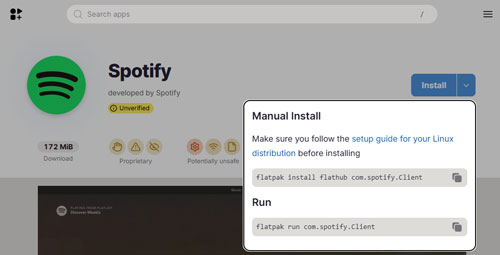
Step 1. Add the official Flathub repository to your system to access the software library by running the command:
flatpak remote-add --if-not-exists flathub https://flathub.org/repo/flathub.flatpakrepo
Step 2. Install Spotify app directly from the repository by typing the command:
flatpak install flathub com.spotify.Client
Step 3. Open the Spotify client from the terminal via the command:
flatpak run com.spotify.Client
To uninstall Spotify app via Flatpak, use the command: sudo flatpak uninstall com.spotify.Client.
Part 4. How to Install Spotify on Linux via AUR
For users who are running Arch Linux, Manjaro, or EndeavourOS, you can use the AUR (Arch User Repository) to get Spotify app to listen to music.
It ensures that you download completely pristine and unaltered binary code directly from the source, seamlessly repackaged specifically for your system. Also, it manages application updates entirely independently of the system's core packages, which effectively prevents the chaotic conflicts that can arise during system upgrades in a rolling-release model and maintains exceptional stability for your operating system.
Step 1. Make sure that you have installed the AUR helper such as yay or paru on your system.
Step 2. Synchronize the package repository database and start the build process via the command:
yay -S spotify
Step 3. Carefully review the package details displayed in the terminal, and then press the "Y" key to confirm the installation.
The terminal will automatically download the binary files, resolve all dependencies, and integrate the application into your system menu. Should you need to update the application in the future, simply run the standard 'yay -Syu' command. This command will fetch the latest version of the application alongside your regular Arch system updates.
Part 5. How to Play Spotify on Linux via Spotify Web Player
If there is a little difficult to install Spotify app on Linux by the ways above, then you can get the easy and direct way to use Spotify on Linux. That's to use the Spotify Web Player. In this way, you can easily access Spotify music library and play Spotify music on Linux online. Now, let's check how to do that here.

Step 1. On your Linux computer, launch the web browser you like.
Step 2. Enter the Spotify official website address in the search bar.
Step 3. Then log in to your Spotify account on the login page.
Step 4. Once done, please go to search for any track you want to listen to. Then start playing it online.
To play Spotify music on Linux browser smoothly, you need to enable to play DRM-protected content on your Chrome browser, or, enable the 'Widevine Content Decryption Module' manually in Firefox browser.
Part 6. How to Use Spotify on Linux via Open-Source Tools
Besides the ways above, you can use open-source tools like spotDL, ncspot, spotify-tui, etc. to get Spotify on your Linux. This method is perfect for advanced users who favor tiling window managers and command-line interfaces. Now, we will take spotDL as an example to show you how to use it to download and play Spotify music on Linux.

Step 1. First, you need to install Python 3 and FFmpeg installed on your system.
Step 2. Open your terminal and enter the following command: python -m ensurepip --default-pip to install pip.
Step 3. After that, you can install spotDL by entering the following command: pip install spotDL.
Step 4. Now, open Spotify and find the playlist or album you'd like to download, then copy its link address.
Step 5. Open the terminal, then run the following command: spotDL [URL] to download Spotify music.
Part 7. How to Play Spotify on Linux Offline
It is noted that the methods above all require network connection. You can't stream Spotify music on Linux offline. Even if you have downloaded Spotify songs with Premium account, the files are cached and you can't keep them forever.
So, for users who need offline and permanent Spotify files on Linux, just use AudFree Spotify Music Converter to help you. This reliable tool can download Spotify music and playlists without Spotify premium on your Mac or Windows computer. Also, you can convert Spotify audio content to common audio file formats like MP3, FLAC and so on with it. Besides, you can alter the bit rate and more for Spotify songs. Also, this tool can work fast and keep the original sound quality of Spotify music.
After that, you can then sync them to the local drive on your Linux. At last, you can listen to Spotify audio tracks offline on Linux without the Spotify app or Spotify Web Player.
AudFree Spotify Music Converter

- Losslessly download Spotify music with free Spotify account
- Convert Spotify music to MP3, FLAC, WAV, M4A, etc.
- Play Spotify music on Linux, Sonos, Roku, Chromecast, etc.
- Work at 13X faster speed, edit music quality and parameters
Here is how to use AudFree Spotify Music Converter to convert and download music from Spotify for free use on Linux step by step. Just check them out here.
- Step 1. Import Spotify music/playlists to AudFree Spotify Converter

- Install and open this professional Spotify converter. Then you can discover songs, playlists or albums on the built-in Spotify web player. Next, you can tap '+' > 'Add to list' to load favorite Spotify files to AudFree's conversion window.
- Step 2. Customize output format for Spotify Linux

- This all-in-one Spotify converter allows users to customize output formats and other audio settings to enhance listening experience. Just enter the top menu bar and choose 'Preferences' > 'Conversion' option to personalize audio parameters. If you are using free Spotify account, you'd better to set bit rate as 320 kbps and sample rate as 44,100 Hz to get higher audio quality. After that, touch the 'OK' button to apply.
- Step 3. Download and convert Spotify playlist for Linux

- Once all settings are ready, please simply press the 'Convert' button at the bottom-right corner. You can see the converting process, which means that AudFree Spotify Music Converter is downloading Spotify music and playlists to plain audio files supported by Linux.
- Step 4. Play Spotify music and tracks on Linux
- Once converted, you can click the 'converted' > 'search' icon to to destination folder and locate converted Spotify files on your computer. Now, you just need to move Spotify tracks to the USB flash drive from your Mac or Windows computer and then sync them to Ubuntu computer for playback. Once done, you can use any portable music player, like VLC, to play Spotify playlists on Linux without problem.
If you listen to music from multiple music services, AudFree Streaming Audio Recorder is your best choice. It can download music for playback on your Linux system with ease. This tool supports Spotify, Tidal, YouTube Music, Deezer, Amazon Music, Apple Music, SoundCloud and so on.
Part 8. Troubleshooting Common Spotify Linux Issues
While installing or using Spotify on Linux, some users may encounter issues like Spotify not working, audio lag or else. If so, please check the problems and solutions below.
Spotify App Fails to Open on Linux (DEB Version)
Sometimes, native Debian apps may fail to launch normally via the app launcher due to the process rendering issues.
You can use the command 'spotify --no-zygote' to test and try to open it. If the app opens successfully, you can set this fix permanent. Please open the application's desktop entry file using a text editor (run the command: 'sudo nano /usr/share/applications/spotify.desktop'). Locate the line beginning with 'Exec=' and append the '--no-zygote' flag to the end of that string. After saving the file, your desktop shortcut should return to normal and function perfectly.
Spotify Audio Stuttering or Lag on Linux
For users who use the modern PipeWire audio server, you will face the playback lag, crackling or skipping issue. This is due to Spotify was originally designed for older audio frameworks like PulseAudio or ALSA. In this case, you just need to install the pipewire-alsa and pipewire-pulse compatibility layers to fix the error.
Keyboard Media Keys Not Working
If you can't control Spotify music playback on Linux via physical keyboard, this indicates that your desktop environment has failed to establish communication with the application's interface.
It is noted that Linux systems use the MPRIS (Media Player Remote Interfacing Specification) standard to control various media applications. If your Linux distribution lacks the necessary communication layer, these media control keys will be non-functional. To solve this issue, simply install the 'playerctl' package using your system's default package manager.
Part 9. FAQs about Spotify on Linux
Can I Play Video Podcasts on the Spotify Linux Client?
Yes. But if the video fails to load or displays a green screen, your system is likely missing the multimedia codecs to decode the video format. So, you need to install ffmpeg package alongside your distribution's restricted multimedia extras to solve this issue.
Can I Listen to Spotify Lossless Audio on Linux?
Yes. If you are a Spotify Premium user, you can stream Lossless audio directly via the Linux desktop client. Just go to Spotify app's Setting > Media Quality and choose the quality to Lossless. For true high-fidelity quality, you must use wired headphones or speakers.
Does the Spotify Linux App Support Spotify Connect?
Yes. You can use your Linux device as a receiver or use it to control playback on other smart devices via Spotify Connect feature.
How Can I Minimize Spotify to the Linux System Tray?
Linux does't support minimize the app to the system tray. If you want to do that, you can install a third-party tool called kdocker. Once installed, open Spotify from the terminal via the command kdocker spotify to force the Spotify app window to dock into Linux system tray area neatly.
Part 10. In Conclusion
When you download the Spotify app for Linux, you can use it to listen to music and even download songs with Spotify premium. But Spotify free users can't download music from Spotify on Linux.
Yet, with AudFree Spotify Music Converter, you can download Spotify songs for offline playback forever whether you are a Spotify Free or Premium user. Now, just choose a way you like to get Spotify music on Linux and play Spotify files on it.

Chief Editor


