


Apple Music has become one of the most popular streaming platforms in the world, offering millions of songs, curated playlists, and exclusive releases. While it was originally designed for Apple devices, Windows users can also enjoy Apple Music with a few different methods. Whether you want to stream music, download songs for offline listening, or convert tracks to MP3 for use across multiple devices, Windows PCs have flexible options to access Apple Music's extensive library.
In this guide, we'll cover everything you need to know about using Apple Music on Windows in 2026. You'll learn whether you can download Apple Music on Windows PCs, the official methods for Windows 11 and older versions, and alternative solutions to keep your music accessible even without a subscription. We'll also address common questions and troubleshooting tips to ensure a smooth experience. Curious? Let's keep going.


Part 1. Can You Download Apple Music for Windows PC?
The short answer is yes, but there are some limitations depending on your method. Apple Music is primarily a streaming service, meaning most tracks are protected by digital rights management (DRM). DRM prevents copying, sharing, or playing songs outside the Apple Music ecosystem. This is important to understand because it affects your ability to download songs for offline use and transfer them to other devices.
For Windows users, Apple offers two official ways to access and download Apple Music:
- Apple Music App for Windows 11: This is the latest solution for PCs running Windows 11. It allows users to stream and download tracks for offline listening, manage playlists, and access their entire Apple Music library.
- iTunes for Windows: Older PCs or Windows 10 users can still use iTunes to download and manage Apple Music. iTunes integrates seamlessly with Apple Music, letting you stream, purchase, and store tracks locally.
Beyond these two official applications, Apple offers a convenient web-based alternative for all Windows PCs: the Apple Music Web Player. You can even install it as a Progressive Web App (PWA) for quicker access. While it is highly functional, please note that it does not support offline downloads.
Both solutions require an active Apple Music subscription. While you can stream tracks without downloading, offline access is only available if your subscription is valid. Once your subscription ends, you lose access to downloaded songs, though purchased tracks remain yours permanently.
Part 2. How to Download Apple Music on Windows 11 via Apple Music App
As of 2026, Apple Music offers full native support for Windows 11, making it easier than ever to stream and download songs directly on your PC. Compared with the old iTunes experience, the dedicated Apple Music app features a cleaner interface, smoother performance, and better music library management for Windows users.
You can install the app directly from the Microsoft Store and enjoy offline playback, synced playlists, personalized recommendations, and high-quality audio on your computer.
Before Apple released the full standalone Apple Music app for Windows, users had to rely on the Apple Music Preview app as an early testing version.
Steps to Download Apple Music on Windows 11 via Apple Music App
Step 1. Open the Microsoft Store on your Windows 11 computer and search for Apple Music. Click the 'Install' button to download and install the application. Once finished, launch the app on your PC.
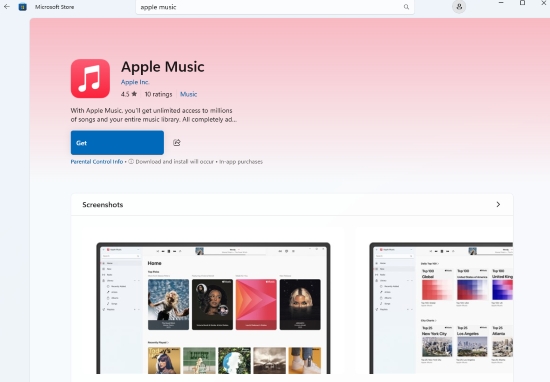
Step 2. Click the 'Sign In' button in the top menu and enter your Apple ID credentials. If two-factor authentication is enabled, complete the verification process. After logging in successfully, your Apple Music library, playlists, albums, and recommendations will automatically sync to the app.
Step 3. Browse or search for any song, album, or playlist you want to save offline. Click the three-dot icon next to the music item and choose 'Download'. The app will begin downloading the selected tracks to your computer.

Step 4. To find your offline downloads, go to 'Library > Downloaded' inside the Apple Music Windows app. The app also allows you to remove downloads or manage storage preferences, ensuring that your PC doesn't get overloaded.
If you don't require offline downloads, the Apple Music Web App is a great alternative. Simply visit music.apple.com, click the 'Install' icon in the browser's address bar, and pin it to your taskbar for quick access. While this version provides a native-app feel, please note that it does not support offline listening and caps audio quality at 256 kbps AAC.
Part 3. How to Get Apple Music on Windows 10/Older PCs with iTunes
If you're using Windows 10 or an older version, iTunes remains the most reliable option for Apple Music access. While iTunes may feel slightly dated compared to the Windows 11 app, it offers robust download and library management features.
iTunes is a versatile choice for any Windows PC, supporting both local libraries and Apple Music streaming. However, it lacks Dolby Atmos support and cannot match the superior audio quality found in the newer Apple Music app.
Steps to Download Apple Music on Windows 10/Older PCs with iTunes
Step 1. Search for 'iTunes' on Microsoft Store and hit 'Get' to install it on your Windows 10 or older PCs.
Step 2. Choose the 'Account' section at the top left corner of iTunes.
Step 3. Touch 'Sign in' to log in with your Apple ID and password.

Step 4. Press the 'Music' tab in the top left corner.
Step 5. Touch on 'Apple Music' > 'Try it now' and sign up for Apple Music according to the prompts.
Step 6. Browse and select songs, playlists, or albums from the Apple Music library. Then tap on the 'Download' icon (a cloud with a downward arrow). Wait until the download completes. These files will be stored locally, allowing offline playback.

By default, Apple Music downloads via iTunes are stored in: C:/Users/[Your Username]/Music/iTunes/iTunes Media/Music. You can also adjust the storage location on iTunes via 'Eidt > Preferences > Advanced'.
Part 4. How to Download Apple Music to MP3 on Any Windows PC
As mentioned earlier, songs downloaded directly from Apple Music are protected by DRM technology. This means the downloaded files can only be played within authorized apps and devices linked to your subscription. In addition, once your Apple Music subscription expires, all offline downloads will become inaccessible.
To permanently save Apple Music songs on your computer and play them freely on any device, you will need a professional Apple Music converter.
One reliable solution is AudFree Apple Music Converter. This powerful tool can batch convert Apple Music tracks, albums, playlists, podcasts, and audiobooks to common audio formats such as MP3, FLAC, WAV, AIFF, M4A, and M4B at up to 17X faster speed while preserving original sound quality and ID3 tags.
After conversion, the downloaded Apple Music files become standard local audio files that can be permanently stored on your Windows PC, transferred to USB drives, uploaded to DJ software, or played offline without the Apple Music app.
AudFree Apple Music Converter

- Converted protected Apple Music to MP3, FLAC, WAV, AIFF, and more
- Batch download Apple Music tracks at up to 17X faster speed
- Save Apple Music as permanent local files for offline playback
- Play Apple Music on non-Apple devices and media players
- Customize bitrate, sample rate, audio channel, and output settings
Before starting, make sure you have an active Apple Music subscription and install AudFree Apple Music Converter on your Windows PC.
- Step 1. Add Apple Music to AudFree Apple Music Converter

- Launch AudFree Apple Music Converter on your computer. Sign in to your Apple Music account through the built-in web player. Then browse your library and select the songs, albums, or playlists you want to download. Click the "+" button and choose 'Add to List' to import the selected Apple Music tracks into the conversion window.
- Step 2. Customize Output Settings for Apple Music

- Click the 'menu' icon in the upper-right corner and go to 'Preferences > Conversion'. Here, you can choose your preferred output format, including MP3, FLAC, WAV, AIFF, Lossless, M4A, and M4B. For maximum compatibility across devices and players, MP3 is usually the recommended option. You can also personalize the Apple Music bit rate, sample rate, audio channels, etc. for original audio quality and spatial audio effects such as Dolby Atmos.
- Under the 'Output' tab, you can designate your preferred destination folder and customize the specific ID3 tags you wish to include.
- Step 3. Convert Apple Music to MP3 on Windows

- After finishing the settings, click the 'Convert' button in the lower-right corner of the 'Converting' section to start downloading and converting Apple Music songs. Once the process is complete, you can find all converted Apple Music files in your selected output folder. These tracks are now DRM-free and can be played offline anytime without requiring the Apple Music app or an active subscription.
- You can also transfer the files to USB drives, SD cards, DJ software, smart TVs, car players, or other devices for flexible playback.
- Step 4. Organize Your Music Library
- Since AudFree Apple Music Converter preserves ID3 tags automatically, your converted files will retain important metadata such as artist name, album title, artwork, and track information. You can easily organize your Apple Music downloads into folders by artist, album, or genre, making it easier to manage large music collections for offline listening, backup, or DJ use.
If you're looking to expand your Windows music library beyond Apple Music, AudFree Streaming Audio Recorder is highly recommended. Supporting over 10 major platforms, it allows you to capture high-quality audio from Spotify, Tidal, Amazon Music, and more with ease. Additionally, it offers flexible output options, including MP3, FLAC, and WAV, to suit any listening preference.
Part 5. FAQs About Apple Music on Windows
How do I add local files to the Apple Music Windows app?
To integrate your own music (like your personal FLAC or MP3 collection), simply go to 'Settings' > 'Files' and ensure 'Keep Apple Music Media folder organized' is checked. You can then drag and drop your local files directly into the app window, or go to the sidebar and select 'File' > 'Add to Library or File' > 'Import'. If you have Sync Library enabled, these files will be uploaded and become available on your other Apple devices.
Do I keep my Apple Music downloads if I cancel my subscription?
No. Apple Music is a subscription-based streaming service, not a store. If your subscription lapses, the DRM (Digital Rights Management) protection will prevent the files from playing, and they will eventually be removed from your local storage. To keep your music permanently, you would need to purchase songs individually from the iTunes Store or use a specialized conversion tool to create unprotected backups, like AudFree Apple Music Converter.
Why can't I download songs from Apple Music on my PC?
This is often caused by a disabled Sync Library setting. To fix this, go to 'Settings > General' and ensure 'Sync Library' is toggled on. Additionally, check that you have enough disk space on your PC and that you are signed in with the correct Apple ID associated with an active subscription.
Why is the Apple Music app not working on my Windows PC?
If the app crashes or fails to load, try the Windows 'Repair' function. Navigate to 'Windows Settings > Apps > Installed Apps', find Apple Music, and select 'Advanced Options > Repair'. If the issue persists, ensure your Windows Media Player Legacy component is installed, as the Apple Music app relies on certain Windows media frameworks to function properly.
Why is the Apple Music download button missing on my computer?
The download button (the cloud icon) only appears if the song is already in your Library but not yet on your hard drive. If you don't see a '+' or a cloud icon, first add the song to your library. If it still doesn't appear, you may be using the Web Player (PWA) version, which does not support offline downloads. Switching to the official app from the Microsoft Store will resolve this.
Conclusion
Using Apple Music on a Windows PC is easier than ever in 2026, thanks to official support for Windows 11 and continued iTunes compatibility for older systems. Whether you stream tracks, download them for offline listening, or convert songs to MP3, Windows users have multiple ways to enjoy Apple Music's expansive catalog.
By following the three methods offered, you can unlock the full potential of Apple Music on Windows, enjoy offline playback, and integrate your favorite songs seamlessly into any workflow - whether for casual listening or professional DJ use.

Staff Editor


