


If you're wondering whether Apple Music has a web player or if you can listen without installing the app, the short answer is yes. Apple Music features an official web player that allows subscribers to access the entire music catalog and their personal library directly from any web browser.
Besides basic music playback, it now supports features such as playlists, lyrics, queue controls, recommendations, radio, and a MiniPlayer. Still, the browser experience is not identical to the native Apple Music app, particularly when it comes to offline listening and deeper device integration.
In this guide, we'll explore what Apple Music Web Player can do, how to use it, how it compares with the app, and what alternatives to consider when browser playback isn't enough.
View also: How to Download Apple Music Online


Part 1. What Is Apple Music Web Player?
Apple Music Web Player is the browser-based version of Apple Music available at music.apple.com. Instead of installing the Apple Music app, you can open the website in a compatible browser, sign in, and access Apple Music directly from the web. It provides access to the Apple Music catalog and your personal library without requiring a dedicated app.
View also: Apple Music Preview Windows 11 App Review
This makes the web player particularly useful when you are using a computer or device where installing the native app is inconvenient or unavailable. For example, you can use it when working in a browser-based environment, switching between your phone and Windows pc, or simply prefer not to install another application.
After signing in, the browser player can connect to your Apple Music experience rather than functioning as a separate music service. Depending on your account and region, you can access music from your library, search the Apple Music catalog, explore personalized recommendations, listen to radio, and manage your music from the browser.
Apple Music features and available content can vary by country or region, so some options may not be available everywhere.
Part 2. What Can You Do with Apple Music Web Player?
The Apple Music Web Player now offers most of the essential features for everyday listening, from streaming and music discovery to playlist management and playback controls. Here are its key features, along with the main advantages and limitations.
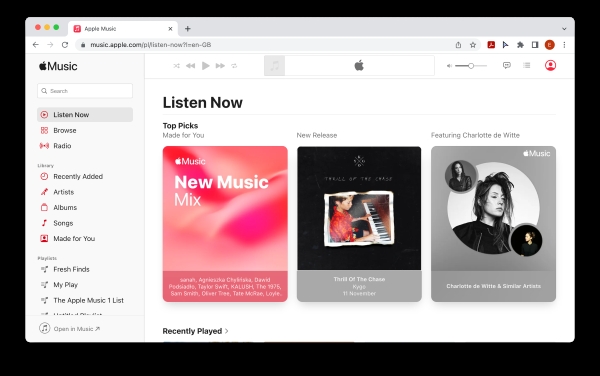
✅ Stream Apple Music in a browser: Listen to Apple Music without installing the desktop or mobile app, with access to both the Apple Music catalog and your library.
✅ Search and browse music: Find songs, albums, artists, playlists, genres, charts, and other Apple Music content directly from the web.
✅ Create and manage playlists: Create, edit, delete, and add songs to playlists without switching to the native app.
✅ Personalized recommendations: Explore music recommendations, new releases, personalized playlists, and other content based on your listening activity.
✅ Lyrics and playback controls: View available lyrics and use controls such as shuffle, repeat, queue, autoplay, volume, and playback order.
✅ Apple Music Radio: Listen to Apple Music radio stations and explore music beyond your personal library.
✅ MiniPlayer: Keep playback controls, lyrics, and the Up Next queue accessible while using other browser content.
✅ Music sharing: Share songs, albums, playlists, radio stations, and other Apple Music content through available sharing options.
Overall, the Apple Music Web Player has evolved into a fairly complete browser-based music experience.
Advantages and Limitations of the Apple Music Web Player
Convenient for shared, work, or storage-limited computers;
Access Apple Music from different desktop environments without installing a dedicated app;
Streaming, library access, playlists, recommendations, lyrics, radio, and playback controls are all available in the browser;
The MiniPlayer lets you keep music controls accessible while working in other browser tabs
The Web Player for Apple Music requires an internet connection;
Does not provide the offline listening or download;
Lacks the full Lossless/Hi-Res Lossless experience available through supported native apps and devices;
Playback and some features can vary depending on the browser and device being used;
Device-level controls and certain advanced Apple Music functions are still better supported in the dedicated app
Part 3. How to Use Apple Music Web Player to Play Music Online
If you have never used the web-based version of Apple Music, the following instructions will guide you to use the official web player to listen to Apple Music online in simple steps.
Step 1. Visit music.apple.com via any web browser on your mobile or desktop.
Step 2. Log in to your Apple account by clicking on the 'Sign in' button at the upper-right corner.

Step 3. After signing in, the web player can load your Apple Music experience, including your library and available personalized content.
If you don't have an Apple Music subscription, the available playback experience may be limited.
Step 4. Select a song or album and click 'Play'. While listening, you can use the playback controls to adjust the volume, shuffle or repeat songs, and manage the queue. You can also open the Lyrics panel when lyrics are available.
View also: How to See Lyrics on Apple Music
If you want to keep the player out of the way, you can also switch to the Web Player's MiniPlayer by reducing the browser window width while a song is playing.
From the Web Player for Apple Music, you can also manage your listening experience as you go. For example, you can create playlists, add songs to them, mark music as a favorite, manage the playback queue, explore personalized recommendations, and switch between different sections of Apple Music. These changes are linked to your Apple Music account, so your library, playlists, and other supported preferences can stay in sync across your devices.
Part 4. How to Fix Apple Music Web Player Not Working
Although Apple Music on the web is designed to work directly in a browser, you may occasionally encounter problems such as the page not loading, songs refusing to play, playback stopping unexpectedly, or the site failing to recognize your account.
Before switching to another method, you can try the following fixes.
Fix 1. Check Your Internet Connection
Apple Music Web Player relies on an active internet connection for streaming. If the connection is unstable, the site may take a long time to load or playback may stop unexpectedly.
Try opening another website first to check whether your connection is working normally. If possible, switch to a more stable network and reload Apple web player.
Fix 2. Sign Out and Sign In Again
Account authentication can occasionally cause problems with web-based services. If Apple Music loads but your library, subscription, or personalized content doesn't appear correctly, sign out of your Apple Account and sign in again.
Then check whether your Apple Music library and playlists have returned.
Fix 3. Clear Browser Cache and Cookies
An outdated cache or corrupted browser data can sometimes interfere with web applications. Try clearing the cached data and cookies associated with Apple Music, then reopen music.apple.com.
Keep in mind that clearing cookies can sign you out of Apple Music websites, so make sure you know your account credentials before doing so.
View also: How to Clear Cache on Apple Music
Fix 4. Disable Problematic Browser Extensions
Privacy extensions, content blockers, script-blocking tools, and other browser add-ons can occasionally interfere with complex web applications, like Apple Music Web Player. If Apple Music doesn't load correctly, temporarily disable extensions, especially those that modify or block page content, and reload the site.
If the player works afterward, re-enable extensions one by one to identify the source of the problem.
Fix 5. Update or Try Another Browser for Apple Music Login
If the problem continues, make sure your browser is up to date. You can also try opening Apple Music in another mainstream browser. If it works normally there, the problem may be related to the original browser's settings, extensions, cache, or compatibility.
Fix 6. Check Apple's Service Status
Sometimes the problem isn't caused by your browser at all. If Apple Music suddenly stops working across different browsers or devices, check Apple's system status page for an ongoing service issue before changing your settings.
If none of these fixes resolve the issue, check Apple's Music support resources, particularly if the problem appears to be related to your Apple Account or subscription rather than the browser itself. If you're looking for a different way to listen, you can also explore the Apple Music browser player alternatives covered in Part 6.
View also: How to Fix Apple Music Not Working on Mac
Part 5. Apple Music Web Player vs App: What's Different?
The Apple Music web player can now handle many of the everyday tasks that were once limited to the native app. So, is there still a reason to use the Apple Music app instead?
Yes, the answer depends on how you prefer to access Apple Music. The main differences between the Apple Music online web player and app are less about basic music playback and more about offline listening, device integration, and the overall native experience.
| Feature | Apple Music Web Player | Apple Music App |
|---|---|---|
| Installation | ❌ | ✅ |
| Access | Browser | Dedicated app |
| Music Playback | ✅ | ✅ |
| Access Music Library | ✅ | ✅ |
| Create & Manage Playlists | ✅ | ✅ |
| View Lyrics | ✅ | ✅ |
| Queue, Shuffle, & Repeat | ✅ | ✅ |
| MiniPlayer | ✅ | ✅ |
| Offline Listening | ❌ | ✅ |
| Lossless Listening | ❌ | ✅ |
| Device Integration | Browser-dependent | More integrated |
| Updates | Web-based | App updates |
Key Differences of Apple Music Online Player vs Apple Music App
1. Offline Listening
The biggest difference is offline playback. The Web Player is designed primarily for streaming, while the Apple Music app lets subscribers download Apple Music for offline listening. This makes the app more practical when you have limited or unreliable internet access.
2. Device Integration
The native Apple Music App is more closely integrated with the operating system and supported devices, providing a more seamless overall experience. The Apple Music Browser Player is more flexible - you can simply open a browser, sign in, and start listening without installing anything.
View also: How to Play Apple Music on Android TV
Which One Should You Use?
For everyday streaming, music discovery, playlists, lyrics, and playback controls, the Web Player for Apple Music covers most needs. If you need offline listening, Lossless audio, or deeper device integration, the native app is the more suitable option.
In short, the Web Player prioritizes accessibility and convenience, while the app offers a more complete native listening experience.
Part 6. Top Alternatives to Apple Music Browser Player
The Apple Music Web Player works well for everyday streaming, but it may not be ideal in every situation. If you run into browser-related issues, need offline playback, or want a more flexible local music library, there are a couple of alternatives worth considering.
Alternative 1. Apple Music App
As discussed in the previous section, the Apple Music app offers several advantages over the Web Player, especially for offline listening and device integration.
If the Web Player isn't working properly or you simply prefer a native experience, the official Apple Music app is the most straightforward alternative. It also lets subscribers download Apple Music for offline playback, which is useful when traveling or in areas with an unreliable internet connection. Apple provides the app for supported iPhone, iPad, Android, Mac, and Windows devices.
Choose the Apple Music app if you want:
- Offline listening through downloaded content
- A native app experience
- Better integration with supported devices
- The simplest alternative to browser streaming
Alternative 2. Keep Apple Music as Local Files with AudFree
If you want more than temporary offline playback within the Apple Music app, a local-file workflow may be more suitable. For example, you may want to manage your music independently, play it with compatible software, or use local audio files across different devices.
In this case, AudFree Apple Music Converter provides an alternative approach. Available for Windows and macOS, it can process Apple Music tracks into common formats such as MP3, M4A, FLAC, WAV, AIFF, and M4B, while retaining metadata and artwork. You can also adjust available output parameters and process multiple tracks at once.
AudFree Apple Music Converter

- Download Apple Music to MP3, M4A, FLAC, and more
- Work at up to 17X speed while keeping ID3 tags
- Adjust output parameters such as bit rate and sample rate
- Support albums or playlist batch processing
- Provide a built-in web player and a local-file workflow for offline playback
- Step 1. Add Apple Music Songs to AudFree

- Launch the AudFree Apple Music Converter and log in to your Apple Music account within the built-in player. Then select the songs, albums, or playlists you want to process and click the '+' button to load them to the conversion list.
- Step 2. Set the Output Format & Parameters for Apple Music

- Go to 'AudFree Apple Music Converter' > 'Preferences', and open the output settings. You can choose a format such as MP3, M4A, FLAC, WAV, AIFF, or M4B. Besides, you can also adjust the available audio parameters to suit your playback needs.
- Step 3. Start the Conversion from Apple Music Songs to Local Files

- Under the converting section, click the 'Convert' button to start the conversion process and wait for it to finish. The downloaded files will be saved to your selected output folder, where you can manage them as local audio files.
Make sure your use of any converted content complies with applicable copyright laws, Apple's terms, and the rights associated with the music.
Beyond the alternatives to the Apple Music web player above, AudFree Streaming Audio Recorder is also a reliable option for you. It serves as an all-in-one web player and downloader for over 10 major streaming platforms, including Apple Music, Spotify, Tidal, SoundCloud, and more.
Part 7. FAQs About Apple Music Web Player
Can I Create Playlists on Apple Music Web Player?
Yes. The current Apple Music web player supports creating, editing, and deleting playlists. You can also add music to playlists while browsing and listening.
Can I Download Apple Music from the Web Player?
Nope. The Apple Music online player is designed primarily for streaming. Apple's current instructions for downloading Apple Music for offline listening use the Apple Music app on supported devices rather than the web player.
Does Apple Music Web Player Support Lossless Audio?
No. Apple Music supports Lossless Audio for subscribers, but the available audio quality can vary depending on the playback method, device, and listening environment. In the web player, music is streamed in AAC at up to 256 kbps, which is a lossy format rather than lossless audio.
If lossless playback is your priority, use the Apple Music app on a compatible device. Alternatively, you can use a dedicated tool such as AudFree Apple Music Converter if you want to save Apple Music tracks in a lossless format.
Conclusion
Apple Music Web Player has developed into a much more capable browser-based music player than its early versions. You can now use it to stream Apple Music, access your library, manage playlists, view lyrics, control the queue, explore recommendations and radio, and use a MiniPlayer - all without installing the native Music app. For users who mainly want convenient browser-based streaming, it can cover most everyday listening needs.
However, the web player does come with limitations - most notably, the lack of official offline playback compared to a local music workflow. If you require offline listening through official channels, the native Apple Music app is the simplest choice. Alternatively, if you need greater flexibility with local audio files across multiple devices, AudFree Apple Music Converter offers an effective alternative solution.

Staff Editor


