


Apple Music offers access to over 100 million songs, making it one of the most popular music streaming services for Mac users. Downloading Apple Music on a Mac sounds simple, but many users quickly discover limitations. While Apple Music lets subscribers save songs for offline listening, the downloaded tracks are protected and can only be played inside the Music app.
So what if you want to:
- Download Apple Music playlists to a MacBook for travel?
- Keep songs after canceling Apple Music?
- Transfer Apple Music downloads to a USB drive or MP3 player?
In this guide, you'll learn both the official Apple Music download method and an alternative way to save Apple Music as local audio files for permanent access on your Mac.


Part 1. What You Need Before Downloading Apple Music on Mac
Before downloading Apple Music songs or entire playlists to your Mac, there are a few requirements you should be aware of.
First, you'll need an active Apple Music subscription (either a paid tier or an active promotional trial). The download feature is only available to subscribers. Besides the paid plan, you'll also need:
- A Mac running a supported version of macOS
- The Apple Music (Music) app installed and updated
- A stable internet connection for initial data streaming
- Enough storage space for your downloads
- Sync Library enabled under Apple Music settings
It's also important to understand how Apple Music downloads work. Unlike purchased songs from the iTunes Store, Apple Music downloads are subscription-based offline copies. They are designed for listening within the Music app rather than for permanent ownership.
This means that downloaded songs remain accessible only while your Apple Music membership stays active. If you cancel your subscription or lose access to your Apple ID, those downloads can no longer be played.
To help you quickly evaluate these baseline prerequisites and structural limitations at a glance, refer to the matrix below:
| Requirement | Needed? |
|---|---|
| Apple Music Subscription | ✅ (Active trial or paid tier) |
| Native Music App | ✅ |
| Internet Connection | ✅ |
| Offline Playback | ✅ (Only inside authorized apps) |
| Permanent Ownership | ❌ (Tied completely to active subscription) |
Once you're familiar with these requirements and limitations, you're ready to start downloading your favorite music.
If you want to bypass Apple Music's native DRM restrictions and establish permanent ownership of your entire Apple Music library, feel free to skip directly to Part 3 to learn how to backup your music as unprotected local files, like MP3.
Part 2. How to Download an Entire Apple Music Playlist on Mac (Official)
If your primary objective is simply to listen to Apple Music offline through the official ecosystem, the native macOS Music app's built-in download feature is your most seamless and easiest option. Downloading your tracks locally eliminates cellular data consumption and allows you to enjoy your Apple Music catalog on your Mac entirely without an internet connection.
The steps below will guide you through the process of downloading Apple Music on Mac using your active subscription.
Step 1. To get started, launch the pre-installed Music app on your Mac and log in to your Apple Music credentidals.
Step 2. Navigate to the sidebar on the left and select 'Playlists'. Click on the specific playlist you want to make available offline. If the playlist was created by someone else or imported from the 'Browse' tab, you must add it to your cloud collection first.
Step 3. Click the '+ Add' icon to add to your Library. Or, you can click the "..." icon and choose the "Add to Library" option.

Step 4. Next, open the playlist you added before and click the 'Download' button (downward arrow icon) near the playlist title. Apple Music will begin downloading every song in the playlist to your Mac automatically.

Alternatively, once the sync is complete, head over to the Library tab in the iTunes on macOS 10.14 and earlier. When you add a playlist, a Cloud icon with a downward arrow will appear next to it. Clicking this button immediately queues every single track in that playlist for background downloading straight to your Mac.

Step 5. Once the download is complete, you can disconnect from the internet and continue listening through the Music app. To view downloaded content only, navigate to: 'Library > Downloaded'. This section displays all songs, albums, and playlists currently available offline.
Or, if you want to access your downloads on Finder, you can access them through the route: /Users/[YourUsername]/Music/Music/Media/Apple Music/.
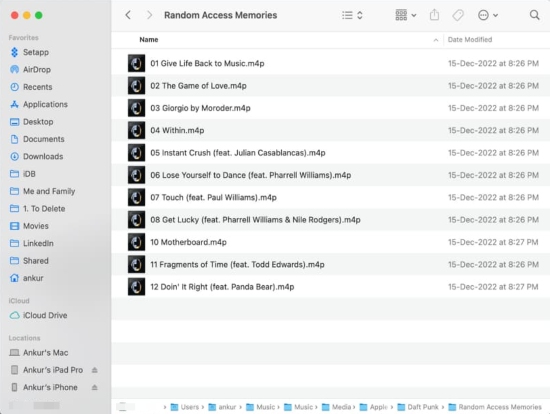
See also: Where Does Apple Music Download To
By the way, if you find the Dolby button next to the music you are downloading, it means it is available in Dolby Atmos and you can download it in Dolby Atmos or stereo. To do that, you can go to 'Music' > 'Preferences' > 'General' > tick the 'Download Dolby Atmos' box.

What Happens After Downloading Apple Music
After downloading, Apple Music stores the tracks locally on your Mac for offline playback. However, these downloads are not standard MP3 or FLAC files.
Instead, they remain protected Apple Music files linked to your subscription account. As a result, you can:
✅ Listen offline inside Apple Music app
✅ Sync downloads across Apple devices
✅ Enjoy lossless audio (Dolby Atmos)
But you cannot:
❌ Copy songs to a USB drive
❌ Transfer tracks to MP3 players
❌ Import them into DJ or video-editing software
❌ Keep them after your subscription ends
For users who simply need offline listening, the official download feature works perfectly. But if you want more flexibility and permanent ownership, you'll need another solution.
Part 3. How to Download Apple Music on Mac as Local Files (Permanent Backup)
As we established, the official Apple Music download feature works well for offline listening, but it doesn't create transferable audio files. The downloaded tracks remain protected and can only be played within the Apple Music app while your subscription is active.
If you'd like to back up Apple Music tracks as MP3, FLAC, WAV, or other common formats for playback on USB drives, MP3 players, DJ software, or non-Apple devices, you'll need an additional solution. To make it, converting Apple Music to local files is a more practical solution.
To do that, a dedicated tool such as AudFree Apple Music Converter for Mac can help you save Apple Music tracks as common audio formats, including MP3, FLAC, WAV, AIFF, M4A, and M4B. It also offers options for users to customize the output preferences, like bit rate, channel, and so on. For the ID3 tags of your Apple Music songs, such as title, cover, album, genre, etc., you can keep them intact.
AudFree Apple Music Converter

- Convert Apple Music to MP3, FLAC, WAV, AIFF, M4A, and M4B for offline backup
- Download Apple Music tracks for offline playback on any device
- Retain ID3 tags and metadata automatically
- Convert music at up to 17× faster speed while preserving audio quality
- Customize output parameters for a personalized listening experience
How to Download Music from Apple Music on Mac as Local Audio Files
Download and install the software on your Mac. Once launched, the Apple Music web player will open automatically within the program.
- Step 1. Add Apple Music to AudFree Apple Music Converter

- Log in using the Apple ID associated with your Apple Music subscription and browse your music library in the built-in Apple Music web player. Next, select the songs, albums, or playlists you want to save locally and add them to the conversion list by hiting the '+' icon.
- Step 2. Define Output Parameters for Apple Music

- Once your Apple Music songs have been loaded, touch the AudFree Apple Music Converter button on the top menu bar. Then choose 'Preferences'. On the pop-up window, specify an output format like MP3, FLAC, AIFF, WAV, or M4A as needed. For more advanced customization, you can also adjust the output bit rate, sample rate, and audio channel according to your needs.
See also: How to Convert Apple Music to FLAC
- Step 3. Download Apple Music as Local Audio Files on Mac

- After configuring the output settings, click 'OK' to save your preferences. Then click the 'Convert' button in the Converting section to begin processing your Apple Music tracks. After conversion, the songs will be saved as regular audio files on your Mac, allowing you to access them directly through Finder just like any other local music file.
- Unlike official Apple Music downloads, these files are no longer restricted to the Apple Music app. You can organize, back up, and manage them freely on your computer or transfer them to other compatible devices for offline playback.
With the downloaded MP3, FLAC, WAV, or other supported formats, you can:
- Back up your Apple Music collection for long-term storage
- Copy songs to USB drives and external hard disks
- Transfer music to MP3 players and other portable devices
- Import tracks into DJ and video-editing software
- Play Apple Music songs without opening the Apple Music app
- Enjoy your music across multiple devices and platforms
This flexibility is one of the biggest differences between standard local audio files and Apple's built-in download feature. In the next section, we'll compare the two methods side by side to help you determine which option best suits your needs.
Want to back up more than just Apple Music tracks? If you are looking for absolute media freedom across multiple platforms, the AudFree Streaming Audio Recorder for Mac has you covered. It lets you capture bit-perfect audio from up to 10 major music streaming services and saves them straight to your Mac as high-fidelity, unrestricted local files.
Part 4. Official Apple Music Downloads vs Local Files: Real Test Results
To better understand the differences between these two approaches, we tested them using the same Apple Music playlist on a Mac. The playlist contained 100 songs and was downloaded twice: once using the official Apple Music app and once using the AudFree local-file conversion method.
The Test Environment:
- Hardware: MacBook Air (M3 Silicon)
- Operating System: macOS Tahoe
- Audio Source: Apple Music (Hi-Res Lossless enabled)
- Network: Wi-Fi 5 Generation
- Test Subject: 100-song curated playlist
Key Results
The differences between the two methods were more significant than expected:
| Feature Dimension | Official App Download Method | Local File Conversion (FLAC 24-bit/192kHz) |
|---|---|---|
| Official Download Time | ~ 2 Hours | ~ 20 Mins |
| Transferable Files | ❌ | ✅ |
| Subscription Required | ✅ | ❌ |
| Permanent Access | ❌ | ✅ |
| Transfer to USB | ❌ | ✅ |
| Play on MP3 Players | ❌ | ✅ |
| Use in Video Editors | ❌ | ✅ |
| File Format Control | ❌ | ✅ |
| Metadata Retention | ✅ (Limited) | ✅ (Full ID3 Tag Support) |
When downloading the 100-track Hi-Res playlist, the Official Download Time took about 2 Hours (mainly subject to Apple server throttling and Wi-Fi stability), whereas the Local File Extraction (FLAC Lossless) took just about 20 Minutes, utilizing the software's advanced hardware acceleration.
Technical Comparison
| Category | Official Apple Music Download | Local File Conversion Method |
|---|---|---|
| Output Format | Encrypted M4P container | MP3, FLAC, WAV, M4A, AIFF, M4B, LOSSLESS |
| DRM Protection | Fully protected (FairPlay DRM) | DRM removed |
| File Access | App-restricted playback only | Fully local files |
| File Longevity | Expires when subscription ends | Permanent storage |
| Device Compatibility | Apple devices only | Universal (USB, MP3 players, DJ tools, etc.) |
| Metadata Handling | Managed internally by Apple | Stored as standard ID3 tags |
| Conversion/Download Speed | Depends on network speed | Up to 46× faster processing |
Conclusion from the Test
While Apple Music's official download feature is convenient for offline streaming, it remains heavily restricted by DRM and device limitations. In contrast, local file conversion provides full ownership, broader compatibility, and significantly faster processing for large music libraries.
Part 5. FAQs About Downloading Apple Music to Mac
Can I Download Apple Music on Mac Without a Subscription?
Officially, no. The native Apple Music app blocks all offline downloads and streaming features the second your subscription tier ends. However, if you purchase Apple Music songs from iTunes or use a third-party audio converter (like AudFree) while your trial or subscription is active, those MP3 or M4A files remain completely functional on your Mac forever, even after you cancel your subscription plan.
How to Download All Apple Music Songs at Once on Mac?
The macOS Music app famously lacks a unified 'Download All' button for your entire music collection. To make it, you can open the 'Music' app on your Mac and select the 'Songs' category from the sidebar, then press 'Command (⌘) + A' to highlight every track in your entire library. Next, right-click the highlighted list and choose Download from the dropdown menu.
Alternatively, you can go to 'File > New > Smart Playlist', set the rule matching parameter to 'Artist is not empty', and it will automatically generate a dynamic playlist containing every single song you own, which you can download with one click.
Why Won't Apple Music Download Songs on My Mac?
If Apple Music downloads aren't working, the issue is usually caused by three common reasons:
• Sync Library Disconnected: Go to 'Music' > 'Preferences' > 'General' and verify that the 'Sync Library' checkbox is turned on. If it is disabled, your local app cannot communicate properly with your iCloud cloud library database.
• De-authorized System Account: Your Mac can occasionally fall out of sync with security tokens. Go to the top account menu bar, click 'Account > Authorizations > Authorize' This Computer, and enter your Apple ID credentials to refresh your device permissions.
• Insufficient Hard Drive Disk Space: High-quality audio files consume significant drive space. Clean out your system cache or move large personal files to free up processing room for incoming tracks.

Conclusion
Apple Music on Mac allows easy offline listening, but official downloads are encrypted and locked inside the Music app, meaning they cannot be exported or used as standard audio files. If you only need temporary offline playback, the built-in method is enough. However, it does not provide true ownership or cross-device flexibility.
To gain permanent access, users can convert Apple Music into local files like MP3, FLAC, or WAV using dedicated tools, like AudFree. This enables playback on any device, USB transfer, editing, and long-term backup. In short, official downloads prioritize convenience, while local file conversion offers full control and ownership of your music library.

Staff Editor


