


Mercedes-Benz vehicles are known not only for comfort and performance, but also for advanced in-car technology. With the introduction of the MBUX infotainment system and Mercedes me services, listening to music in a Mercedes has become smarter and more immersive than ever. For TIDAL users, especially those who value high-quality and lossless audio, a common question arises: How can I play TIDAL in my Mercedes?
The good news is that Mercedes supports TIDAL in multiple ways - both officially and through alternative methods. Whether you prefer native integration, offline playback without buffering, or simple phone connections, there is a solution for every situation. In this guide, we'll walk you through five proven ways to play TIDAL in Mercedes, and answer the most common questions related to sound quality, voice control, buffering, and MBUX features.


Part 1. How to Play TIDAL in Mercedes via Mercedes MBUX (Official Way)
What Is TIDAL Integration in Mercedes MBUX?
Mercedes-Benz has partnered with TIDAL to offer native TIDAL streaming inside the MBUX infotainment system on selected models. When supported, TIDAL appears as a built-in music app directly on the vehicle's display, allowing you to browse playlists, albums, and recommendations without relying on your phone.
This integration is designed to deliver a seamless, dashboard-native experience, especially in newer Mercedes vehicles equipped with the latest MBUX software.
Requirements to Use TIDAL in Mercedes
To use TIDAL through MBUX, you typically need:
- A Mercedes vehicle equipped with MBUX
- A Mercedes me account
- An valid TIDAL subscription (Mercedes offers 3-month free trial for new Mercedes Driver)
- Vehicle compatibility and regional support
- A stable mobile data connection (via built-in SIM or tethered data)
Native TIDAL Mercedes MBUX integration is subject to regional availability and specific vehicle configurations; therefore, support may vary even among MBUX-equipped models.
Tip: If you've recently purchased a new Mercedes, open the Mercedes me app and check the Special Offers section. Many users are eligible for a complimentary 3-month TIDAL trial to get started.
See also: How to Get Tidal Free Trial 6/3/1 Months
How to Set Up and Use TIDAL in MBUX
If you own a newer Mercedes-Benz model, you can enjoy a fully integrated TIDAL experience. Before you can stream directly through your dashboard, you must link your TIDAL account to your Mercedes me profile and sync it with the MBUX system. Follow the three-phase process below to get started.
Phrase 1. Activate "Online Music" via the Mercedes me App
The first step is ensuring your vehicle is digitally authorized to stream music.
Step 1. Open the Mercedes me connect app on your smartphone.
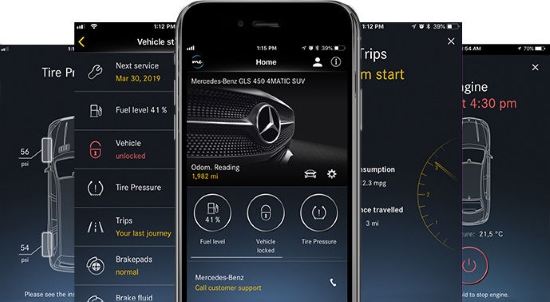
Step 2. Tap the Menu (three horizontal lines) or the Vehicle icon.
Step 3. Navigate to Manage Services (or Digital Extras). Scroll down to Online Music and make sure the toggle is switched ON.
Phrase 2. Link Your TIDAL and Mercedes me Accounts
Next, you need to "introduce" your TIDAL credentials to the Mercedes ecosystem.
Step 4. Within the Mercedes me app, go to the Settings or Vehicle Information tab.
Step 5. Locate Music (or Online Music) and select TIDAL from the list of available providers.
Step 6. You will see an option to Link Account or Sign In.
Step 7. A browser window will open, redirecting you to the TIDAL login page. Enter your credentials to authorize the connection.
Step 8. Once authorized, the app will show that your TIDAL account is successfully linked to your Mercedes me ID.
Phrase 3. Sync Mercedes me Tidal with the MBUX Infotainment System
Finally, initialize the service inside your vehicle.
Step 9. Get into your Mercedes and start the engine to power up the MBUX system.
Step 10. On the center touchscreen, tap the Media icon.
Step 11. Look for the Online Music source on the left-hand menu or under the Sources tab.

Step 12. Select TIDAL and sign in with your TIDAL credentials (or scan the QR code to log in).
Step 13. Your playlists, favorited albums, and "My Collection" should now populate on the screen automatically.
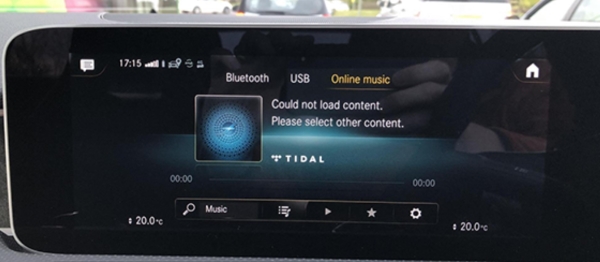
Once configured, TIDAL integrates perfectly into your driving experience, allowing for seamless touchscreen navigation and "Hey Mercedes" voice commands.
Limitations of the Official Method
While the native integration is convenient, native TIDAL in Mercedes has some notable drawbacks:
❌ No offline playback: You cannot download tracks to the car's hard drive; you must have an active connection to play music.
❌ Data dependency: High-fidelity streaming requires a robust and consistent data plan, which may incur extra costs.
❌ Potential buffering: In rural areas, parking garages, or tunnels, the music may stutter or stop entirely.
❌ Bitrate Constraints: Real-world cellular signal fluctuations can often force the system to downgrade your audio quality from "Max" to "Standard".
For drivers who frequently travel long distances or demand uninterrupted, Hi-Res quality lossless playback, these limitations can be a dealbreaker. To resolve these issues, we provide a superior alternative in Part 2 - please read on to learn how to play TIDAL offline in your Mercedes.
Part 2. How to Play TIDAL in Mercedes Offline Without Buffering (Lossless Quality)
Why Native TIDAL in Mercedes Doesn't Support Offline Playback?
You may be wondering why the native TIDAL integration in Mercedes-Benz lacks an offline playback feature. The answer lies in the architecture of the Mercedes MBUX system.
Unlike brands like Polestar or Volvo, which utilize a full Android Automotive OS, Mercedes-Benz uses its own proprietary software. While full Android Automotive systems occasionally allow certain apps to utilize local storage, the MBUX TIDAL app functions differently. It is essentially a specialized web-app wrapper that lacks the necessary permissions to store or cache large media files on the vehicle's primary drive.
Furthermore, the MBUX integration is designed strictly for online streaming rather than functioning as a full-featured TIDAL application. A critical barrier is TIDAL's encryption: the service protects its downloaded music files so they can only be accessed and decrypted within an official TIDAL app.
Consequently, TIDAL tracks cannot be recognized by the Mercedes infotainment system or copied to the vehicle's internal storage - even though Mercedes natively supports local music playback for other file types
The Best Solution: Playing TIDAL via USB Drive
Mercedes-Benz vehicles widely support USB audio playback, allowing you to play local music files stored on a USB flash drive or external hard drive. Supported formats usually include:
• MP3
• AAC
• WAV
• FLAC (lossless)
If your TIDAL music is converted into one of these formats, it can be played fully offline through the Mercedes infotainment system - without buffering, data usage, or signal drops.
So the key question becomes: How do you convert TIDAL music into Mercedes-supported audio formats?
To download and convert TIDAL music into formats compatible with Mercedes systems, you need a reliable and professional tool. Among available options, AudFree Tidal Music Converter stands out as an essential solution. This professional desktop tool is designed to batch-download TIDAL tracks while preserving the original Hi-Res quality and metadata. It makes AudFree Tidal Music Converter an ideal tool for preparing a high-quality, offline TIDAL library for Mercedes playback.
AudFree Tidal Downloader

- Lossless download TIDAL tracks, albums, and playlists (Hi-Res FLAC)
- Convert Tidal to MP3, FLAC, WAV, etc. for Mercedes playback
- Retain ID3 tags and metadata (artist, album, cover art)
- Support batch downloading at up to 37× conversion speed
How to Download Tidal Music to USB for Mercedes Offline Playback
To enjoy buffer-free TIDAL playback in your Mercedes, follow these simple steps to convert your music and transfer it to a USB drive.
- Step 1. Customize Tidal Music Output Format and Other Settings

- After installing AudFree Tidal Music Converter on your computer, launch the program and log in to your TIDAL account using the built-in web player. Next, open the top menu and go to Preferences > Conversion to select your preferred output format, such as FLAC, MP3, WAV, etc. You can also customize advanced parameters, including bitrate, sample rate, and audio channel.
- Under the Output tab, you can choose the destination folder and manage ID3 tag settings to keep your music library well organized.
- Tip: For the best Tidal sound in your Mercedes, choose FLAC or WAV with a bit depth of 24-bit.
- Step 2. Add Tidal Music to AudFree Tidal Music Converter Conversion List

- Once the settings are saved, browse your favorite TIDAL playlists, albums, or tracks. Click the + button and select Add to List to load them into the conversion list. AudFree Tidal Music Converter supports batch processing, allowing you to add and convert multiple songs or entire playlists at once without limitations.
- Step 3. Download and Convert Tidal Music for Mercedes

- Click the Convert button to start downloading and converting your selected TIDAL music. The process runs efficiently in the background, maintaining the original audio quality. After conversion, click the Converted icon to view all downloaded tracks. You can then locate the files directly in the output folder on your computer.
- Step 4. Play Tidal Music in Mercedes Offline

- Finally, copy the converted TIDAL music files to a USB flash drive. Insert the USB drive into your Mercedes USB port, open the Media section on the infotainment system, and select the USB source. You can now enjoy offline, lossless TIDAL playback in your Mercedes - with no buffering, no data usage, and no interruptions.
Advantages of Playing TIDAL via USB in Mercedes
✅ True offline playback - no internet required
✅ No buffering or interruptions
✅ Superior audio quality, especially with FLAC files
✅ Full control over your music library
✅ Ideal for long road trips, rural areas, and remote areas
For audiophiles and frequent drivers alike, USB playback remains the most reliable and highest-quality way to enjoy TIDAL in a Mercedes.
Part 3. How to Play TIDAL in Mercedes Using Apple CarPlay or Android Auto
If you prefer the interface of your smartphone, Apple CarPlay and Android Auto are also excellent alternatives. Using Apple CarPlay or Android Auto is also one of the easiest and most stable ways to stream TIDAL in a Mercedes-Benz. Once connected, you can control TIDAL directly from the MBUX screen while enjoying safer, hands-free playback.
Most modern Mercedes models support at least one of these smartphone integration platforms, Apple Carplay or Android Anto.
Method 1. How to Stream TIDAL to Mercedes via Apple CarPlay (iPhone)
Best for: iPhone users
Audio Quality: 16-bit/44.1kHz (CD quality)
Requirements:
- iPhone 6 or later
- iOS 13 or above
- Active TIDAL subscription
- Mercedes-Benz with CarPlay support
- USB cable or wireless CarPlay support
Step 1. On your iPhone, go to Settings > General > CarPlay and enable CarPlay to turn on.

Step 2. Find the USB port marked with a smartphone integration symbol (an icon of a phone next to a screen). And Plug your iPhone into the USB port. Or use wireless Carplay if your Mercedes supports.
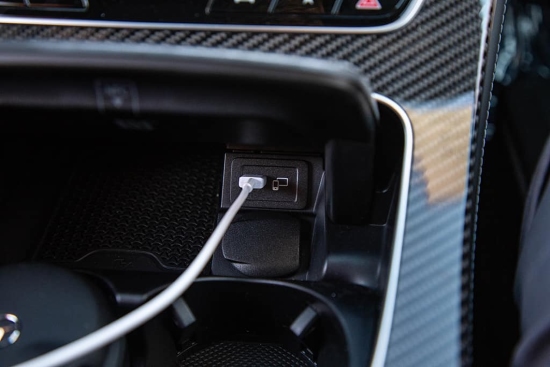
Most Mercedes-Benz vehicles require a physical connection; however, 2021 and later models (MBUX 2.0) often support wireless connections. For optimal results and the highest audio bitrates, use an Apple-certified or high-speed USB-C cable for the wire connection.
Step 3. A prompt will appear on your iPhone asking to "Allow CarPlay with 'Mercedes-Benz' while phone is locked". Tap Allow.
Step 4. On the Mercedes infotainment screen, select 'Start Automatically' when the data protection disclaimer appears.
Step 5. Find the TIDAL icon on the CarPlay interface and sign in to your account.
Step 6. Browse playlists, albums, or downloaded content and play TIDAL directly through your Mercedes speakers.
When using Apple CarPlay, TIDAL streams data in real-time. Consequently, your audio playback quality is directly tied to the stability of your mobile network.
See also: How to Play Tidal on CarPlay
Wired Carplay vs Wireless Carplay: Which should you use?
If your Mercedes supports both, choosing the right one depends on your priorities:
| Feature | Wired Connection | Wireless Connection |
|---|---|---|
| Audio Quality | Higher (Stable 16-bit FLAC) | Lower (Uses a WiFi/Bluetooth mix; prone to interference) |
| Stability | Excellent (No lag or drops) | Fair (Can occasionally stutter in high-interference areas) |
| Charging | Charges your phone while you drive | Drains phone battery (unless using a wireless pad) |
| Convenience | Must plug in every time | Automatically connects when you enter the car |
Method 2. How to Stream TIDAL to Mercedes via Android Auto (Android)
Best for: Android users
Audio Quality: 16-bit/48kHz (CD quality)
Requirements:
- Android phone running Android 8.0 or later
- Android Auto installed and updated
- Mercedes-Benz with Android Auto support
- USB cable or wireless Android Auto

Step 1. In the Settings app, open Android Auto settings and grant required permissions.
Step 2. Use a USB cable or wireless Android Auto connection if supported.
Step 3. Select Android Auto from the Mercedes infotainment menu.
Step 4. Tap the TIDAL icon from the app list.
Step 5. Control playback using the touchscreen, steering wheel buttons, or voice commands.
Tip: For a hands-free experience, ensure your voice assistant is active (Siri/Google Assistant). You can use commands such as::
"Siri, play my 'Daily Discovery' on Tidal." or
"Hey Google, play some Jazz on Tidal."
See also: How to Play Tidal on Android Auto
Pros and Cons About Playing TIDAL in Mercedes Using Apple CarPlay/Android Auto
| Pros |
✅ Easy Setup: Simple plug-and-play functionality ✅ Familiar Interface: Uses the same mobile UI you are used to ✅ CD Quality: Better fidelity than standard Bluetooth ✅ Up-to-Date: The app is updated through your phone, ensuring latest features |
| Cons |
❌ Phone Dependent: Requires your device to be connected at all times ❌ Data Heavy: Relies entirely on your mobile data plan ❌ Audio Limitations: No support for Dolby Atmos or Spatial Audio ❌ Potential Latency: Less stable than a direct USB drive connection |
This method is ideal for drivers who prioritize a familiar user experience and convenience over the absolute peak of audio fidelity.
🔔 Note on Audio Quality: While CarPlay and Android Auto are significantly better than Bluetooth, they typically cap audio at 16-bit/44.1kHz or 48kHz (CD quality). For those seeking lossless or 24-bit Hi-Res audio, the native MBUX app or the USB method still remains the superior choice.
Part 4. How to Stream TIDAL to Mercedes via Bluetooth
Bluetooth is the most universal and quickest option. Simply pair your phone with your Mercedes vehicle and play TIDAL through the phone's audio output.
Step 1. Turn on Bluetooth on your phone.
Step 2. On your Mercedes MBUX screen, go to Phone > Connect Device > Search for your Phones.
Step 3. Select your phone from the list and confirm the 6-digit code matches on both your phone and the car screen.

Step 4. Once paired, go to Media and select Bluetooth Audio as your source.
Step 5. Open the TIDAL app on your phone and press play.
Bluetooth is best suited for
• Older Mercedes models without CarPlay or MBUX TIDAL support
• Short trips
• Casual listening where sound quality is not critical
While Bluetooth is convenient, it has clear limitations:
❌ Audio compression reduces sound quality (much lower than Carplay or Android Auto)
❌ No lossless, Hi-Res playback or Dolby Atmos
❌ Limited track metadata display
❌ No native voice control for TIDAL
❌ Less integration with MBUX
❌ Potential connection drops
Part 5. FAQs About Playing TIDAL in Mercedes
How do I activate the 3-month TIDAL trial through Mercedes me?
To redeem your trial, open the Mercedes me app and navigate to Available Services or Partner Offers. If the promotion is available for your region and vehicle, follow these steps:
1. Log in to the Mercedes me portal using your credentials.
2. Select your vehicle and click on the Online Music icon.
3. Scroll down to activate your TIDAL account by entering your preferred email and password.
4. Click 'Sign Up' to confirm.
5. Once registered, download the TIDAL app on your smartphone or desktop to begin creating playlists. You can even explore exclusive Mercedes-Benz curated playlists.
Is the sound quality better using the native MBUX app or Apple CarPlay/Android Auto?
The native MBUX TIDAL app generally offers superior audio quality because it can access higher bitrates and spatial audio features directly through the car's hardware. However, for the absolute highest stability and permanent ownership of your library, downloading TIDAL tracks to a USB drive via AudFree Tidal Music Converter is the best solution, as it ensures 100% lossless playback without relying on a signal.
How do I enable Hi-Res audio quality in the MBUX TIDAL app?
Navigate to the Settings menu within the TIDAL app on your MBUX screen and select the highest streaming quality (e.g., Max). Note that this requires an active TIDAL subscription and a strong, stable internet connection.
Can I listen to TIDAL Dolby Atmos tracks in my Mercedes?
Yes, provided your vehicle is equipped with a compatible Burmester® 3D or 4D Surround Sound System. Dolby Atmos support also depends on your specific MBUX software version and the availability of Atmos-mastered tracks on TIDAL. If all available, use the native tidal mercedes or usb offline playback can make this aim.
What should I do if TIDAL keeps buffering while driving?
Buffering is usually caused by poor cellular reception. To fix this, you can try connecting to a mobile hotspot or lowering the streaming quality in the settings. For a completely buffer-free experience, we recommend using the USB offline playback method.
Why is the 'Online Music' icon missing from my MBUX Media menu?
The icon may be missing if the Online Music service has not been activated in your Mercedes me account (showed in Part 1 Phrase 1), if your subscription has expired, or if the feature is not supported in your specific region or vehicle model year.
How do I switch from TIDAL to FM radio using voice commands?
You can simply say: 'Hey Mercedes, switch to FM radio' or 'Hey Mercedes, play [Frequency] FM'.
In Conclusion
Playing TIDAL in Mercedes Benz is easier and more flexible than many drivers expect. From native MBUX integration and CarPlay/Android Auto to Bluetooth streaming and offline lossless USB playback, each method serves a different need.
If you want the best balance of convenience and integration, native Mercedes MBUX TIDAL is ideal. For users who prioritize sound quality and stability, offline USB playback is unmatched. By choosing the right method, you can enjoy TIDAL in your Mercedes exactly the way you prefer - whether on daily commutes or long road trips.

Staff Editor


