


Apple Music has built-in equalizer (EQ) controls that can help you adjust how your music sounds, whether you want stronger bass, clearer vocals, more detail, or a more balanced listening experience. However, where you find the EQ and how much control you get depends on the device you're using.
In this guide, we'll show you how to use the Apple Music equalizer on iPhone, iPad, Mac, Windows, and Android, explain the best Apple Music EQ settings for different listening needs, and show you how to create a custom EQ. We'll also cover third-party EQ options, common problems, and useful troubleshooting tips.


Quick Answer: What Is the Best EQ for Apple Music?
If you simply want to know which Apple Music EQ to try first, use the table below as a starting point.
| Listening goal | Apple Music EQ to try | Why |
|---|---|---|
| Best overall / general listening | Pop or Flat | A relatively balanced starting point |
| More bass | Bass Booster | Emphasizes the lower frequencies |
| Bass + energetic sound | Hip-Hop | Adds more low-end impact with a livelier presentation |
| Clearer vocals | Vocal Booster / Spoken Word | Brings more attention to the vocal range |
| Rock & metal | Rock | Gives guitars, drums, and highs more presence |
| Classical & jazz | Classical / Jazz | Keeps the presentation relatively balanced |
| Pop | Pop | A convenient starting point for mainstream music |
| R&B | Pop/R&B or a mild custom EQ | Can keep vocals and low-end relatively balanced |
| Late-night listening | Late Night | Designed for a more consistent listening level |
| More treble / brightness | Treble Booster | Adds emphasis to higher frequencies |
| Car listening | Rock or Loudness | Can provide a more energetic starting point in a noisy environment |
| AirPods | Flat first, then adjust to taste | Avoids adding unnecessary tonal changes before evaluating the headphones |
There is no single Apple Music EQ setting that works best for everyone. If your headphones already have strong bass, for example, Bass Booster may make the sound feel too heavy. Likewise, increasing treble can improve perceived detail but may make sibilant vocals or bright recordings sound harsher.
Part 1. How to Use Apple Music Equalizer on iPhone/Android/Mac/PC
Apple Music provides built-in EQ controls on some platforms, but the way you access them depends on your device. iPhone and iPad users access the EQ through the device's Music settings, while the Apple Music apps on Mac and Windows provide their own Equalizer controls. Android behavior can vary depending on the phone and its audio settings.
How to Adjust EQ on Apple Music for iPhone/iPad
In current iOS and iPadOS versions, you access Apple Music Equalizer from Settings rather than the main Apple Music playback screen. Apple currently places the control under the Music settings.
Step 1. Click on the 'Settings' app, then tap 'Apps' and select the 'Music' option.

Step 2. Tap on the 'EQ' button under 'Audio' or 'Playback' and select the desired equalizer.
Step 3. Open EQ to browse all available presets. There is a list of more than 20 EQ presets like Bass Booster, Rock, Vocal Booster and so on. Just choose the EQ preset you want to try.
Step 4. Go to Apple Music to play the song with the new sound effect.
You don't get the same manual frequency-slider interface on iPhone/iPad that you get on Mac or Windows. Instead, the built-in iPhone/iPad EQ is primarily preset-based. For example, you might start with Bass Booster if you want more low-end impact or Vocal Booster/Spoken Word if vocals are difficult to hear.
If you're comparing several presets, use the same song and roughly the same listening volume. Otherwise, a louder setting can easily seem "better" even when the tonal balance is not actually preferable. Usually the EQ setting applies to Apple Music playback on the device.
How to Change Apple Music Equalizer on Mac
The Apple Music app on Mac includes a dedicated Equalizer window with presets and manual frequency controls. You can also save your own custom presets. Apple allows EQ presets to be assigned to individual songs on Mac, which can be useful when different recordings need different tonal adjustments.
Step 1. Launch the Apple Music application on your Mac desktop.
Step 2. Select 'Window' > 'Equalizer' from the top menu bar on the app's screen.

Step 3. On the pop-up Equalizer screen, select a preset or drag the slider to adjust the sound parameters.
Step 4. Tap the 'On' button to turn on the Apple Music Equalizer settings.

How to Use Apple Music Equalizer on Windows PC
With the official launch of the Apple Music app for Windows, PC users can now access built-in EQ presets just like on macOS.
Step 1. Open the Apple Music app on your Windows PC.
Step 2. Open the sidebar actions menu by the three dot and select 'Equalizer'.
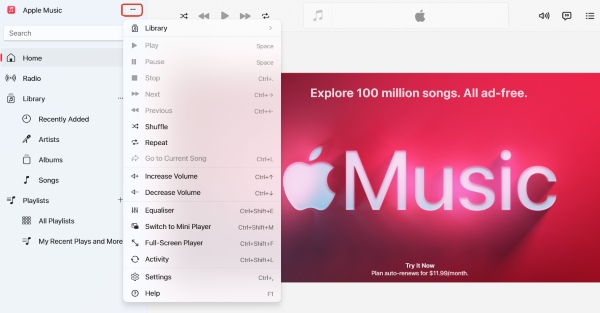
Step 3. Turn on Equalizer and choose one of the available presets.
Step 4. For more control, adjust the individual frequency sliders or create a custom preset.
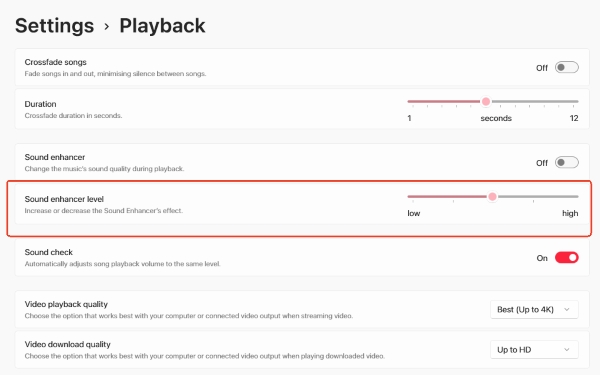
Windows users can also find a 'Sound Enhancer' option in Apple Music's playback settings. This is separate from the EQ and can further change the overall character of the sound.
How to Set Equalizer on Apple Music for Android
Unlike the Mac and Windows versions, the Apple Music Android app does not provide the same built-in graphic EQ with adjustable frequency sliders. Instead, EQ controls may be provided by your Android phone, headphones, earbuds, or another audio device.
Step 1. Navigate to Settings on your Android phone.
Step 2. Scroll down and find the Sound & Touch or Sound & vibration section.
Step 3. Tap Sound Effect, Sound quality and effects or Audio effects > Graphic Equalizer. Then, you can select the preset eq. Alternatively, you can drag the slider to customize an EQ perfect for most of your Apple Music songs.

The exact menu names can differ between Samsung, Google Pixel, Xiaomi, OnePlus, and other Android devices, so there is no single Android path that applies to every phone. If your device does not provide a suitable system EQ, a compatible third-party equalizer may be an alternative. Be aware that third-party equalizer apps and advanced sound adjustments require locally saved audio files. See Part 3 and Part 4 for a bonus method on exporting local Apple Music files and these best equalizers for Apple Music.
Part 2. Best Apple Music EQ Settings and Presets
Above are the steps to use the official equalizer for Apple Music. You may wonder what the best EQ setting for Apple Music? Asking for the "best Apple Music EQ" sounds simple, but the answer depends on what you are trying to change.
There is no single best Apple Music Equalizer setting for everyone. Instead of choosing one preset for every song, start by identifying the problem you want the EQ to solve. The ideal setting depends on the music you listen to, your headphones or speakers, your listening environment, and whether you prefer stronger bass, clearer vocals, or a more neutral sound.
Best Apple Music EQ Presets by Music Genre
Apple Music EQ Presets: What Does Each One Do?
Apple Music provides more than 20 commonly used equalizer presets on its Mac and Windows apps, alongside manual controls for creating your own settings. The exact preset experience can vary by platform, so treat the following descriptions as practical listening guidance rather than fixed technical specifications for every version of Apple Music.
1. Bass Booster - Best for More Bass
Bass Booster is a natural starting point when the low end feels too weak. It can work particularly well with bass-driven genres such as hip-hop, EDM, electronic music, and some forms of pop.
However, more bass is not always better. If your headphones or speakers already emphasize low frequencies, Bass Booster can make the mix sound thick or muddy. You can try Bass Booster when:
- You want more kick from drums and basslines.
- You mainly listen to bass-heavy genres.
- Your current headphones sound relatively light in the low end.
2. Flat - Best for a Neutral Starting Point
Flat keeps the EQ relatively even and is useful when you want to hear your headphones or speakers without additional tonal shaping. It is also a useful reference point when creating a custom EQ. Start with Flat, make one small adjustment, and then compare the result rather than changing several frequency ranges at once.
3. Vocal Booster / Spoken Word - Best for Clearer Vocals/Podcast
Vocal Booster or Spoken Word emphasize the midrange where much of the vocal information is located. If singers or spoken voices sound buried in the mix, they can make spoken content and vocal-focused tracks easier to follow. These settings place more emphasis on the frequency range associated with vocal presence, making them useful for:
- Podcasts
- Audiobooks
- Interviews
- Voice-heavy music
- Songs where vocals feel recessed
If vocals start sounding sharp or nasal, reduce the amount of midrange emphasis rather than simply increasing the volume.
4. Rock - Best for Rock and Metal
Rock can provide a more energetic presentation by emphasizing parts of the low and high frequency ranges. It is a useful starting point for rock, metal, and tracks with prominent drums and electric guitars.
However, the result can vary considerably depending on your headphones. If your system already has bright highs, Rock may make cymbals or guitars sound more aggressive than you prefer.
5. Classical / Jazz - Best for Instrumental Music
Classical and jazz recordings often contain a wide range of instruments and dynamics, so a heavily boosted EQ is not always necessary.
But they (Classical or Jazz) can be a useful starting point when you want to retain the balance between instruments while adding some perceived warmth or clarity.
For acoustic recordings, listen carefully before making additional changes. Excessive bass can obscure lower instruments, while too much treble can make strings, brass, or cymbals sound overly sharp.
6. Pop - Best for General Listening
Pop is one of the easier presets to use as an everyday starting point. It can add a little more excitement to vocals and the overall frequency balance without requiring manual adjustments.
If you switch between many different genres throughout the day, Pop can be more convenient than repeatedly changing a custom EQ.
7. R&B - Best Apple Music EQ for R&B
R&B deserves a little more attention than simply grouping it under Pop. The genre often relies on both a strong low end and expressive vocals, so the best setting depends on which part of the mix you want to emphasize.
For a balanced starting point, try Pop/R&B if that preset is available on your device. Use it if you want:
- More vocal presence: make a small midrange/upper-mid adjustment;
- More bass impact: start with Bass Booster or make a modest low-frequency boost;
- A smoother presentation: avoid excessive boosts in the upper frequencies;
- A balanced R&B sound: start with a moderate preset and adjust only one area at a time
There is no single "perfect" R&B EQ curve for every song. Modern R&B productions can have very different bass, vocal, and treble balances, so the same setting may sound excellent on one track and too heavy on another.
8. Acoustic - Best for Acoustic and Singer-Songwriter Music
Acoustic can work well when you want vocals, guitars, piano, and other natural instruments to remain prominent.
If the recording already sounds clear, Flat may actually be preferable. The goal is not to add as much EQ as possible, but to correct a tonal imbalance that you can actually hear.
9. Treble Booster - Best for a Brighter Sound
Treble Booster emphasizes the higher frequencies, which can make a track sound brighter and more detailed. If your headphones already sound sharp, though, too much treble can make vocals or cymbals uncomfortable.
Use it carefully if you are sensitive to sharp highs or vocal sibilance. Too much high-frequency emphasis can make "s" sounds and cymbals distracting.
10. Late Night - Best for Low-Volume Listening
Late Night is useful when you want to listen at a lower volume while keeping quieter parts of a track easier to hear. It changes the relative balance between quieter and louder parts of the music, which can make softer details easier to hear without simply turning up the volume. It can be particularly convenient when listening:
- At night
- In a quiet room
- Without wanting to increase the volume for quieter passages
However, Late Night is not simply a "louder" EQ. If your main problem is that Apple Music tracks have noticeably different perceived loudness, the separate Sound Check feature is also relevant because Apple describes it as a way to normalize audio volume levels.
Best EQ for Apple Music in Car
Apart from streaming Apple Music songs on a mobile or desktop, many music lovers prefer to streaming Apple Music in a car. A suitable Apple Music equalizer settings for those devices will take you to an awesome auricular spectacular. Without further ado, let's see which is the best Apple Music EQ settings for cars.
For optimal sound in your car, use the Rock or Loudness presets. These enhance clarity and bass for better acoustics in confined spaces. Alternatively, a custom EQ with slightly elevated bass and mid frequencies can reduce low-frequence and road noise and improve vocal detail.
Recommended Apple Music EQ for Car:
- Rock: This is the best starting preset. It will boost the low-end (bass) and high-end (treble). The extra bass blocks out road noise, and the brighter highs make sure things like cymbals and vocals sound clear and crisp.
- Bass Booster: If you're into bass-heavy music like Hip-Hop or EDM and feel the bass fades on the go, this is an easy way to add some extra kick to your tracks.
- Loudness: This preset makes music sound fuller at low volume by adding some extra bass and treble. It keeps things balanced without cranking it up, making it great for podcasts or casual listening.
For an even more consistent listening experience between songs, consider whether Sound Check is more relevant to your problem than EQ. Apple describes Sound Check as a volume-normalization feature, rather than an EQ effect.
View Also: How to Play Apple Music on Tesla
Best EQ for Apple AirPods/AirPods Pro/AirPods Max
There is no universal AirPods EQ that will sound best for every listener. A sensible starting point is Flat or Off, followed by a small adjustment based on what you actually hear. That way, Apple's built-in tech, like Adaptive EQ, can adjust the sound for your ears in real time. If you want the most accurate, 'as the artist intended' experience, keeping the EQ flat is the way to go.
But if you'd rather tweak the sound to match your taste or a certain genre, some EQ presets pair really well with the AirPods' sound profile.
Recommended Apple Music EQ with AirPods/Other Headsets:
- Pop (For a subtle and all-round enhancement): This preset lightly boosts the bass and treble, giving your music a livelier, more exciting feel without changing its overall vibe. It's a great 'set it and forget it' option that works well for almost any genre.
- Hip-Hop or Bass Booster (For deeper and more impactful bass): AirPods already have solid bass, but these presets take it up a notch. The Hip-Hop preset not only adds bass but also brightens the highs, so vocals pop and the sound feels more dynamic. If you're after pure low-end power for EDM or trap, the Bass Booster preset brings the heavy thump.
- Vocal Booster (For maximum vocal clarity or podcasts): If vocals tend to get buried in loud rock songs or you're big on podcasts, this preset is a winner. It boosts the mid-range so voices stand out and are way easier to hear.
- Late Night (For listening at low volumes): This preset evens out the sound by making quiet parts louder and loud parts softer. It's great for late-night listening since you'll catch every detail without cranking the volume and bothering anyone.
Apple also provides separate audio features for supported headphones, including Headphone Accommodations, which can customize headphone audio for media. But because these features can interact with your overall listening setup, avoid stacking multiple aggressive audio enhancements at the same time.
Part 3. How to Create a Custom Apple Music Equalizer
For an even more consistent listening experience between songs, consider whether Sound Check is more relevant to your problem than EQ. Apple describes Sound Check as a volume-normalization feature, rather than an EQ effect.
On Mac and Windows, Apple Music provides frequency sliders that let you increase or decrease different frequency ranges. You can also save your adjustments as a custom preset for future listening.
What Do the Apple Music EQ Frequencies Mean?
You don't need to be an audio engineer to understand the basics. Each part of the EQ mainly affects a different aspect of the sound. Below is a simple and quick explanation on Apple Music Equalizer panel for your reference:

💡Low Frequencies (32 - 400 Hz): This is the entire bass range, covering the deep sub-bass rumble you feel (32-100 Hz) to the main bass. This will provide warmth and fullness to the track (100-400 Hz).
- Boosting these sliders is great for bass-heavy genres like Hip-Hop or EDM. This gives the sound more power and impact
- Cutting these frequencies can reduce muddiness if the bass feels overwhelming, boomy, or muddy.
💡Mid Frequencies (400 - 2 kHz): The midrange affects vocal clarity and the fullness of instruments like guitars and pianos reside. It gives the music its main body and character.
- Boosting these frequencies highlights vocals and melodic instruments, ideal for acoustic or vocal-centric music. That is because it can highlight the singer's voice and the main melody.
- Cutting here can help reduce harshness in crowded mixes.
💡Upper-Mid Frequencies (2 kHz - 6 kHz): This range determines the presence and clarity of the music. It helps the vocals, cymbals and snare drum stand out in the mix.
- Boosting these frequencies to add aggression to electric guitars and make vocals sound more clear and upfront.
- Reducing these frequencies can soften the sound if it feels too sharp or vocals sound nasal.
💡High Frequencies (6 kHz - 20 kHz): This range adds sparkle, brightness and airiness to a track, making the sound crisp and airy.
- Boosting these frequencies is excellent for genres like Classical or Pop, where you want to emphasize clarity and create a sense of open space.
- Reducing high frequencies if the sound is too sharp or if you notice excessive 'sss' sounds (sibilance) in the vocals.
View Also: How to Download Apple Music Classical
Then, you can create the best custom EQ for Apple Music based on your music genre and your own preferences. After you adjusted the frequency sliders you like in the Equalizer window, you can click the dropdown menu and select Make Preset. After that, you can name it and save your custom setting for future use.
Below is some collections of Apple Music Equalizer settings for different music genre. You can take it as a reference. If you have some Apple Music EQ with best sound, please share your settings at the comment below!

A useful approach is to adjust the frequency range related to the problem you are actually hearing instead of changing multiple sliders at once.
How to Build a Custom Apple Music EQ
Step 1. Use the Flat preset as a neutral reference point before making any changes.
Step 2. Then identify one problem. For example, the bass may sound too weak, the vocals may feel buried, or the overall sound may seem too bright.
Step 3. Increase or decrease only the relevant frequencies slightly. Avoid pushing several sliders to extreme levels at the same time.
Step 4. A song you know well makes it easier to notice changes in bass, vocals, instruments, and overall balance.
Step 5. Switch between your custom setting and Flat. If the difference does not clearly improve the listening experience, the adjustment may not be necessary.
Step 6. Save the setting if it works consistently. On Mac and Windows, you can save your custom EQ as a preset and reuse it whenever you want.
A Simple Rule for Custom Apple Music Equalizer
Boost what you want to hear more clearly, but also consider cutting frequencies that may be masking it. For example, if a mix sounds muddy, continuously increasing the treble is not necessarily the best solution. A small reduction in excessive low or low-mid energy may produce a cleaner and more balanced sound.
Again, there is no single "perfect" Apple Music EQ curve. A good custom setting is simply one that solves a specific listening problem without creating another one.
Bonus Tip: Use Apple Music Local Files with More EQ Options
Apple Music's built-in EQ is convenient, but its availability and controls vary by platform. If you want to use your Apple Music library with third-party EQ apps, audio software, or devices that work with standard local audio files, a local-file workflow can provide more flexibility.
One option is to use AudFree Apple Music Converter to save Apple Music tracks as compatible local audio files. It supports formats such as MP3, FLAC, WAV, AIFF, and M4A, while allowing you to customize output settings such as bitrate and sample rate. It also offers lossless output reaching up to 24-bit / 192 kHz, provided the source file supports high-resolution playback.
AudFree Apple Music Converter

- Get rid of protection from Apple Music playlists, tracks, etc.
- Convert Apple Music to MP3, WAV, FLAC, AIFF, etc.
- Support keeping ID3 tags and customizing output music quality
- Set Apple Music with Apple Music Equalizer
Featuring a clean, intuitive interface, the software is straightforward to use. Simply sign in with your Apple Music account, set your preferred output format and audio parameters, search for tracks within the built-in web player, and start downloading.

Once the tracks are available as local files, you can import them into compatible music players or audio applications and use the EQ controls provided by those platforms.
Make sure you only use and export music in ways permitted by your applicable rights, licenses, and the service's terms of use.
Part 4. Best Apple Music Equalizers for Android/iPhone/iPad
Apple Music's built-in EQ is usually enough if you only want to choose a preset such as Bass Booster, Rock, Pop, or Late Night. If you want more detailed control over frequency bands, bass enhancement, stereo effects, or custom profiles, a third-party equalizer may be worth considering.
Once you've extracted your Apple Music library using AudFree, applying custom EQ settings to your local files is effortless - with or without an active internet connection. Best of all, it eliminates device limitations entirely, giving you full control over where and how you listen.
Looking to apply third-party equalizers to tracks from Spotify, Tidal, SoundCloud, or other services beyond Apple Music? AudFree Streaming Audio Recorder is a reliable solution. Compatible with over ten major streaming platforms, it seamlessly exports your music into MP3, FLAC, WAV, and other formats - delivering up to lossless audio quality for custom EQ tuning.
View Also: How to Convert Apple Music M4P to MP3
4.1 Equalizer FX: Bass Booster App (iOS)
It is the best Apple Music EQ app for iPhone and iPad. With its powerful 7-band equalizer and dynamic bass tuning features, you can quickly create your own custom presets. It also includes a bass booster and loudness enhancer to adjust the sound effects of your music to suit your preferences. You can also use the audio filters to modify the frequency envelope of the sound and enhance the stereo effect.

4.2 Boom: Music Player & Equalizer (Android & iOS)
It is one of the best bass boosters and equalizer apps for Android and iOS. With a customizable 16-band equalizer, 3D surround sound, and hand-crafted presets, you can immerse yourself in your favorite music and crossfade Apple Music. You can also create your own custom presets to enjoy music the way you want. It also allows you to listen to music from the Tidal streaming service or store on Dropbox and Google Drive.

4.3 Equalizer+ Pro: HD Music Player (Android & iOS)
Equalizer+ is an all-in-one music player, equalizer, and bass enhancer. With this Equalizer for Apple Music, you can mix, edit, and customize the sound of your tracks to get the best music listening experience. You can adjust the volume and give more depth to your tracks with the 7-band equalizer, as well as 10 equalizer presets based on the music genre.

4.4 Music Volume EQ (Android)
It is an equalizer, bass enhancer, and virtualizer for Android devices. It can also be used as a music player for your phone to play your music with 3D effects. Configured with a 5-band equalizer, it can boost audio, adjust bass and treble levels, and create custom sound profiles to suit your preferences.

4.5 Flat Equalizer: Bass Booster and Volume Booster (Android)
Flat Equalizer provides you with an equalizer, a bass booster, a volume booster and a virtualizer. For best sound results, it is recommended to connect this application with headphones or speakers to feel the best sound quality. Its outstanding features are the 5-band equalizer controller and the surround sound effects. You can enrich your music collection with presets covering various music genres.

Part 5. Apple Music Equalizer Not Working? Try These Fixes
If your Apple Music EQ does not seem to change the sound, don't immediately assume that the equalizer itself is broken. The problem may come from the device, output method, app version, or another audio-processing setting. You can try the following workarounds to resolve this issue:
1) Make Sure that You Have Enabled Equalizer: First, please check if you have activated the equalizer feature in the Apple Music app on your device. If not, turn it on.
2) Update to the Latest Version of Apple Music and Device: It can prevent you from encountering unknown bugs and glitches.
3) Repair Headphones: Please make sure you have connected your headphones to your device correctly.
4) Change into Other Headphones: If the above method makes no sense, it indicates there is a problem with your headphones. Please try switching to another compatible pair of headphones.
5) Use the AirPlay from the Computer's Volume Control: If you are listening to Apple Music with smart speakers, please ensure that you connect the AirPlay from the volume control of your computer instead of using the AirPlay menu inside Apple Music.
6) Try the Top 5 Best Equalizer Apps for Apple Music: If these troubleshooting steps haven't fixed the problem, giving a third-party equalizer a try is your best next step. Paired with AudFree's easy extraction process, you gain total control over your audio with fine-tuned EQ adjustments.
Part 6. FAQs about Equalizer for Apple Music
How to Turn Up Bass on Apple Music?
On iPhone and iPad, you can tap Settings > Music > EQ > Increase Bass to turn up Bass on Apple Music. However, you cannot adjust Bass to a certain frequency. On Mac and Windows, you can use the built-in Apple Music Equalizer and raise the lower-frequency sliders manually.
What Is The Loudest EQ on Apple Music?
Among the presets of Equalizer for Apple Music, Late Night, Bass Booster, or Loudness can increase the Apple Music volume by boosting the bass and treble. If you're Apple Music volume is low, you can try these methods on this guide to make Apple Music louder.
Where Is the Apple Music Equalizer on an iPhone or iPad?
You won't find the EQ directly inside the Apple Music app. On current iOS and iPadOS versions, go to Settings > Music > EQ section. Then choose an available preset.
Why Is the Apple Music EQ Option Greyed Out?
If the EQ option is unavailable or does not appear to affect playback, first check your Apple Music version, device settings, and playback method. External audio routes such as AirPlay can also affect how audio processing is applied.
Is There a Custom EQ for Apple Music on iPhone?
The Apple Music app on iPhone and iPad mainly provides preset EQ options rather than a fully adjustable multi-band EQ. For detailed frequency-by-frequency control, you'll need a compatible third-party solution or a different playback setup.
Conclusion
The best Apple Music equalizer setting depends on what you listen to and how you listen to it. For a quick adjustment, presets such as Bass Booster, Vocal Booster, Rock, or Flat are easy starting points. If your device provides manual controls, a custom EQ can give you more precise control over bass, mids, and treble.
If the built-in Apple Music EQ isn't flexible enough for your setup, you can also explore compatible third-party EQ apps or use local audio files with a wider range of playback and audio-processing tools.
The key is to make small, purposeful adjustments rather than simply boosting every frequency. Start with a preset or Flat, identify what you want to improve, and fine-tune the sound based on your headphones, speakers, music, and personal preference.

Staff Editor


